| A LIBRARY OF SOCIAL SCIENCE REVIEW ESSAY | ||||||||
| WORSHIPPING NATIONS By Richard A. Koenigsberg, Library of Social Science |
||||||||
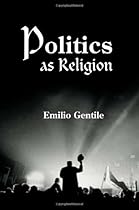
| Gentile, Emilio. Politics as Religion. Princeton, NJ: Princeton University Press, 2006. 194 pp. $52.50 U.S. (cloth) ISBN 9780691113937. |
||||||||
EMILIO GENTILE, Professor of Modern History at the University of Rome, an internationally renowned authority on fascism and totalitarianism, argues that politics over the past two centuries has often taken on the features of religion, defining the fundamental purpose and meaning of human life. Secular political entities such as the nation, state, class, and party became the focus of myths, rituals, and commandments and gradually became objects of faith, loyalty, and reverence.
“Gods” are one class of entities that human beings worship. However, other objects become sacred within societies. One such entity worshipped in the modern world—inspiring a cult of devotion—is the Nation-State. The state may appear as an “enthralling and awe-inspiring power that invokes a feeling of absolute dependency.” Contemporary social theory—focusing on the concept of power—demonstrates how forces “from above” impose themselves upon “the subject.” Gentile puts forth a more sophisticated—psychological—paradigm based on recognition that human beings possess a desire to attach to and worship objects greater than the self. Gustav Le Bon stated that religion originates in the need to submit oneself to a ”divine political or social faith.” This sentiment revolves around worship of a supposed superior being, submitting to its commandments and spreading its dogmas, combined with a tendency to consider as mortal enemies those who “do not submit to the commandments of this superior being.” Fascism is as a form of religion rooted in worship of the nation-state—and of the leader who represents the nation. Gentile writes of the “fusion of the individual and masses in the organic union of the nation” combined with “persecution against those outside the community.” According to the totalitarian fantasy, the individual and state must exist in a condition of “perfect union.” Others who disrupt the experience of perfect union are branded enemies of the state—who must be eliminated. Cultures differ regarding the nature of the entity that is worshipped. Members of society may become devoted to Allah, or to Germany, or to America, or to Communism. What is significant is binding one’s ego to an idea or entity imagined to be omnipotent. Rudolph Otto coined the term numinous to refer to the experience of an “immense, mysterious and majestic power that, through its enthralling and awe inspiring nature, evokes a feeling of absolute dependence.” Hitler evoked the numinous through the experience of “Germany,” particularly at mass rallies when hundreds of thousands of people gathered together to worship the entity that Hitler—like a medium—brought into being. Germany became an immense, majestic power bringing forth a feeling of absolute dependence. Hitler explained to the German people: “You are nothing, your nation is everything.” Compensation for becoming small and insignificant took the form of binding one’s self to an “enthralling, awe-inspiring entity.”
Totalitarianism, Gentile says, revolves around “fusion of the individual and of the masses in the organic and mystical union of the nation.” Mystical union with one’s nation evokes the sense of being bound to a gigantic, powerful object. The religious experience—sense of the sacred—is contained in one’s relationship to one’s nation. In the nation, sacred and secular merge: the numinous experience becomes coextensive with everyday life. Worshipping the sacred object—linking oneself to its mysterious and majestic power—releases an irrational energy driving human beings to “industrious fervor.” The sacred object—awe it evokes—acts as an inspiration and goad to action, bringing about an inner excitement that erupts as the will to sacrifice. Hitler declared: “Our love towards our people will never falter, and our faith in this Germany of ours is imperishable.” He called Deutschland ueber Alles a profession of faith that “fills millions with a greater strength—with that faith that is mightier than any earthly might.” Nazism grew out of a “boundless, all embracing love for the Volk.” “Germany” lay at the heart of the political religion called Nazism. Everything the Nazis did was done in the name of their beloved nation. However, this sacred entity required a representative on earth, Hitler, who embodied Germany and conveyed her mystical power—inspiring fervent emotion and fanatic action. Gentile observes that people experience a profound need to “prostrate themselves,” not simply before great ideals, but also before “individuals who in their eyes incorporate such ideals.” The German relationship to Hitler represented “adoration of a temporal divinity.” What occurred in Nazi Germany—the horrendous actions performed by the German people—grew out of absolute devotion to its leader. As Rudolf Hess put it, “We know nothing but carrying out Hitler’s orders—and thus we prove our faith in him.” Scholars often explain the atrocities carried out by Germans according to the concept of “obedience to authority.” Hannah Arendt wrote about the “banality of evil.” These interpretations are naïve, even fatuous. One might as well say that hysteria evoked by the Fab Four represented “obedience to the Beatles.” Or that the young ladies who swooned when he sang were being “obedient to Frank Sinatra.” The religion that held the German people in thrall continues to dominate the contemporary political landscape: human beings worship their own nation. Indeed, we are so deeply identified with and devoted to this object that we worship that we barely conceive of existence in separation from it. It’s nearly impossible to “imagine there’s no country.” About the author: Richard Koenigsberg received his PhD in Social Psychology from the Graduate Faculty of the New School for Social Research. He is the author of Nations have the Right to Kill and Hitler’s Ideology. |