|
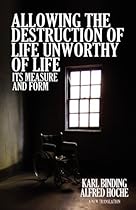
One of the most significant passages in the history of the twentieth century—shaping the Holocaust and Second World War—appeared in 1920, from Alfred Hoche and Karl Binding:
| Are there human lives which have so completely lost the attribute of legal status that their continuation has permanently lost all value, both for the bearer of that life and for society? Merely asking this question is enough to raise an uneasy feeling in anyone who is accustomed to assessing the value of individual life for the bearer and for the social whole.
It hurts him to see how wastefully we handle the most valuable lives (filled with and sustained by the strongest will to live and the greatest vital power), and how much labor power, patience, and capital investment we squander (often totally uselessly) just to preserve lives not worth living--until nature, often pitilessly late, removes the last possibility of their continuation.
Reflect simultaneously on a battlefield strewn with thousands of dead youths, or a mine in which methane gas has trapped hundreds of energetic workers; compare this with our mental hospitals, with their caring for their living inmates. One will be deeply shaken by the strident clash between the sacrifice of the finest flower of humanity in its full measure on the one side, and by the meticulous care shown to existences which are not just absolutely worthless but even of negative value, on the other. |
The two eminent academics—law Professor Alfred Hoche and psychiatrist Karl Bending—proposed that the state was justified in killing “life unworthy of life.”This passage—quoted repeatedly by historians of Nazism and the Holocaust—provided the ideological foundation of the “Euthanasia Program” that took hold in Germany in 1939.
Hoche and Binding ask us to reflect on a “battlefield strewn with thousands of dead youths,” and to compare this scene with “our mental hospitals with their caring for their living inmates.” Upon making this comparison, the authers say, one will be deeply shaken by the strident clash between the sacrifice of the “finest flower of humanity,” on the one hand, and the “meticulous care” shown to existences which are “absolutely worthless,” on the other.
Why does the state show such concern and consideration for the "worst" human beings (the mentally ill)--and so little concern and consideration for the best human beings, who are so promiscuously sent to die on the field of battle.
The proposal for euthanasia—the destruction of life unworthy of life—grew out of this question, generating the following proposition: “If the state is willing to kill its best people—healthy young men who contribute significantly to society---why should the state hesitate to take the lives of people who make no contribution to society, rather are a burden to society?”
The perception that the state is killing its own soldiers did not lead to an anti-war message. Hoche and Binding--and most Germans--were unwilling to abandon their devotion to warfare.
Rather, the state's right and willingness to kill was affirmed, embraced and extended to another class of human beings. If the state can kill its most valuable human beings (soldiers), why can't it also kill the most worthless human beings (mental patients)? Mass-murder in Nazi Germany originated based on this logic.
|