| Library of Social Science develops a Philosophy of Book Exhibits
By Richard A. Koenigsberg
|
|||
| This is Volume II in a series of Newsletters on the history of my relationship with Library of Social Science. To read Volume I, please click here | |||
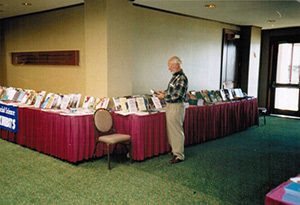
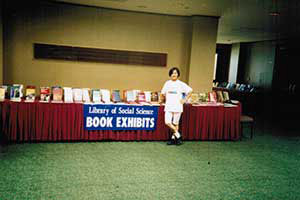
So there I was in July 1988—in a hotel in Secaucus, NJ—at the book exhibit of the International Society of Political Psychology—standing at a table, talking to colleagues and selling books. Having been absent from the academic world for 17 years, I was excited—thrilled even—to partake of civilization. Denis Snook, the conference organizer, had persuaded several other publishers to participate in the exhibit. For four days we existed in a cozy little space, meeting and greeting attendees. Denis continually walked around the space, checking things out. He was in charge of the meeting, and wanted to make certain things were running smoothly. He frequently wandered by the book exhibit—observing Mei Ha and me rapping with conferees and writing up orders—having a good time. He never spoke a word—just watched. Finally, after three or four days, we packed up and were about to depart. I saw Snook, walked up him, shook his hand, and said, “Thanks so much for being so courteous.” He was somewhat bemused: “Why are you thanking me? I didn’t say a word to you throughout the entire conference.” After the meeting, Denis and I began a dialogue that continued for several years. The ideas we developed established the foundation for Library of Social Science Book Exhibits (although I did not have a clue that I was “starting a company”). Denis, an Air Force veteran of the Vietnam War, didn’t feel good about having participated. His devotion to the field of political psychology contained an element of “making amends.” Beginning in 1981 (until 1992), he was conference organizer for every single ISPP meeting. He received a pension from the US government—who thus supported his efforts to establish this new field. Most of Snook’s time each year revolved around planning and organizing the ISPP conference. Having witnessed my performance in 1988, he asked me to take over running the book exhibit. He had plenty of other things to do. I consented to organize the book exhibit for the 1990 ISPP meeting at the Mayflower Hotel in Washington, DC. I created a two-page sales letter and mailed it to perhaps 100 publishers (who had to mail the reservation form back, since in those days there was no email, and I didn’t know what a fax was). Based on follow-up telephone calls, I was highly successful in signing up publishers (perhaps 70 exhibited, a record that stands to this day). The exhibit was a huge success—they had clear space in an entire ballroom--to replace the modestly sized room that had been planned for the display. In subsequent conversations, Denis would relate his philosophy governing the ISPP book exhibit. He wanted to “carve out a niche for the field;” to develop an “ongoing conversation among scholars.” He saw book exhibits as a service to members of the organization—who needed to know about the “latest and most significant developments in the field.” He wanted to provide attendees with a “comprehensive picture of the state of the art in the field of political psychology.” So there it was at the very beginning: the foundation of Library of Social Science Book Exhibits: providing a display conveying the State of the Art in a given discipline. In our heart, the dream remains the same. In our recent prospectus—30 years later—we state that an LSS book exhibit brings together a “comprehensive collection of the latest and most significant books and journals in a the field.” A Library of Social Science book exhibit provide a research function—by gathering together the most significant titles in a field at a single location. It is clear this is what Snook had in mind at the time: to show that political psychology existed as a discipline. My role was to identify significant books on the conference topic or theme, developing a book exhibit while at the same time defining or articulating a field of study. The book exhibit I developed for ISPP in 1992 (in San Francisco, July 4-8) was as successful as the first I’d created in 1990. By bringing so many titles together at the meeting, it was clear that political psychology on its way to establishing itself as a genuine discipline. Indeed, by the 1992 meeting, ISPP hired their first Executive Director, George E. Marcus of Williams College. Subsequent conferences thus were organized in a more systematic way. Soon, they no longer needed Denis Snook. As is the wont for academic organizations, Snook was honored with the “Jeanne Knutson award” at the 1995 ISPP meeting. Denis eventually came to work with me at Library of Social Science—as we applied the book exhibit concept we’d developed for the ISPP to other academic disciplines. What were Snook and I doing in those early days? Were we attempting to start a business, or to establish an academic discipline? Indeed, as LSS Book Exhibits evolved in the Nineties, I frequently presented papers and participated in panels at meetings where I created book exhibits. What was my thinking? Did I create the book exhibit business in order to finance my desire to present ideas at conferences? Or—since I was organizing a book exhibit at a particular meeting, did I say to myself—“What the hell, since I’m attending the meeting as an exhibitor, I might as well present a paper?” From the perspective of Library of Social Science, the business dimension was never separate from my scholarly aspirations. Library of Social Science book exhibits are unique in terms of their size and scope. Take a look at these wonderful photos. In our promotional literature, we state that LSS creates exhibits of unsurpassed quality. Our exhibits are a sight to behold. Conference attendees are not only impressed, but often stunned by the quality of the displays. At the 1992 ISPP meeting, the well-known political psychologist Jerrold M. Post conveyed the experience of a Library of Social Science book exhibit parsimoniously. I greeted him—one of the most important ISPP members—the first time he walked into the hotel ballroom where our exhibit was located. The room was brightly lit, our 14 tables filled with 300 titles. Post looked at the set-up over and expressed his appreciation: “Holy shit!” |