 |
 |
| Mass-graves, World War I & the Holocaust |
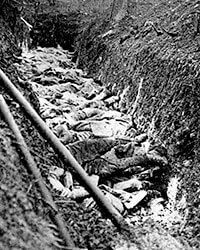
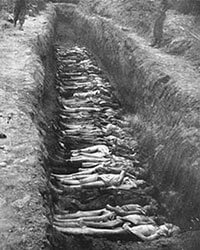
The photo on the left is of German soldiers dead in a trench, World War I. The photo on the right is of Jews, buried in a trench.
What was the Holocaust? For Hitler, it was a reenactment of the First World War.
As German soldiers had been slaughtered in the First World War, so Jews would be slaughtered in the Holocaust. Hitler would compel Jews to experience what German soldiers had experienced: death at the hands of the nation-state (but with words like "heroism" subtracted).
Hitler would attempt to master the trauma of the First World War by turning passivity into activity.
DO UNTO OTHER AS HAS BEEN DONE UNTO YOU.
|
 |
OMER BARTOV
Brown University
Professor of European History
Professor of German Studies
|
|
|
In "Industrial Killing: World War I, the Holocaust, and Representation," Omer Bartov states that the First World War introduced to the West a “new concept of war” that had far-reaching consequences. He calls this “industrial killing,” the “mechanized, impersonal and sustained mass-destruction of human beings, organized by states.” This “mass slaughter in the trenches,” Bartov explains, has had a “direct and long-lasting effect on Europe,” and subsequently on the rest of the world.
In Murder in Our Midst: The Holocaust, Industrial Killing, and Representation (Oxford University Press, 1996), Bartov suggests that the “very concept of mass-killing of human beings by states”—the genocide of the Jews—was “lifted directly from the Great war”—from the realities of 1914-1918.
The death camps were architecturally and organizationally modeled on the experience of the Great War, “incorporating all the attributes of a military environment,” such as uniforms and barbed wire, watch towers and roll calls, hierarchy and order, drill and commands. The Holocaust was therefore a “militarized genocide.”
Bartov observes that what was present during the First World War was also present at the death camps: the barbed wire, machine guns, charred bodies, the gas, the uniforms, and the military discipline. This reenactment, however, had the great advantage that it was “totally lethal for the inmates and totally safe for the guards.
The word “reenactment” is apt. I hypothesize that the Holocaust represented a reenactment of the First World War.
Hitler fought in the First World War for four years, 1914-1918, witnessing the slaughter of hundreds of comrades. He was in the trenches to receive artillery bombardments (nearly killed himself on several occasions). Crawling as a messenger, it’s a miracle he survived the machine gun bullets. At the end of the war, Hitler was the victim of a poison gas attack—nearly blind in a hospital when the war ended.
The key concept illuminating the Holocaust in its relationship to the First World War is “Do unto others as has been done unto you.” In creating the death camps, Hitler was recreating or reenacting his own traumatic experience of the First World War, as well as Germany’s trauma.
Two-million German soldiers died in the First World War, and millions more were injured. Hitler was well aware of the statistics. In the Holocaust, there would be no German victims—only Jews.
Bartov concludes by observing that there is much reluctance to “associate the imagery of the Great War with the Holocaust.” This has to do both with the discomfort of “perceiving national wars as instances of industrial killing,” and with the general tendency to insist on the “difference between genocide and war.”
Was there actually a substantial difference between the slaughter that occurred during the First World War and the slaughter that occurred during the Holocaust? Some might say that the killing that occurred in the Holocaust was intentional, whereas the killing that occurred in the First World War was unintentional.
If a General asks a man to get out of a trench and to run into machine gun fire and artillery shells is his death unintentional?
|