|
Bin Laden’s mentor Abdullah Azzam-- called the “Lenin of international jihad”--produced a philosophy of history more concise than that of Hegel or Nietzsche:
“History does not write its lines except with blood. Glory does not build its loft edifice except with skulls. Honour and respect cannot be established except on a foundation of cripples and corpses.
Empires, distinguished peoples, states and societies cannot be established except with examples. Indeed, (one cannot) change reality, or change societies, without blood, sacrifices and invalids, without pure, innocent souls.” |
Empires, states and societies--the creation of history, Bin Laden explains-- builds upon “cripples and corpses.” Islamic terrorism and suicide bombings are one of many phenomenon that enact and demonstrate the truth of Azzam's proposition.
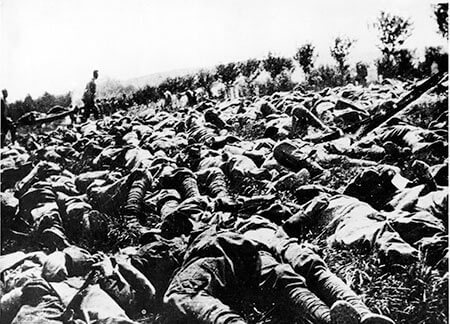
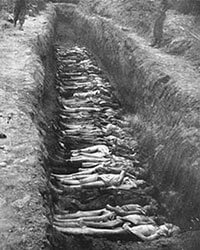
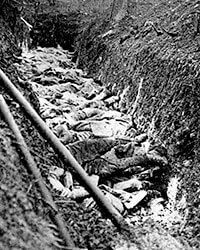
History is created when historians write books about leaders such as Napoleon, Douglas Haig, Hitler, Stalin, Emperor Hirohito and Mao--whose actions produced a prodigious number of “cripples and corpses.” The function of historians (and journalists) is to record the number of cripples and corpses that leaders and societies produce.
History, Azzam says, grows out of the “blood of the martyr” and the “ink of the scholar.” In other words, history requires:
- A leader who inspires the people of a society to enact violent acts.
- A populace willing to engage in violent activities at the behest of their leaders and society.
- Human beings who killing.
- Human beings who die because of violence enacted by the society. These "diers" include both enemy casualties and members of one's own society (sacrificial victims).
At the heart of this entire process are journalist, who convey what occurs to members of society through newspapers, magazines, and more recently radio, television and the Internet.
And historians, who memorialize the killing and dying--the blood sacrifices that have been enacted by societies.The job of historians is to make certain that the dying and killing have not been in vain--by "remembering" what occurred.
Historians write monumental narratives about monumental events like genocide and war. This is the history of the human species.
But what about the causes of these events; the reasons they occurred? Rarely remembered. Relegated to the dustbin of history.
What do we remember? What is memorialized? The killing and dying itself. The number of cripples and corpses that were produced. The greater the number of deaths that were generated, the more "significant" the historical event; the more important the political leader who generated the killing and dying.
|