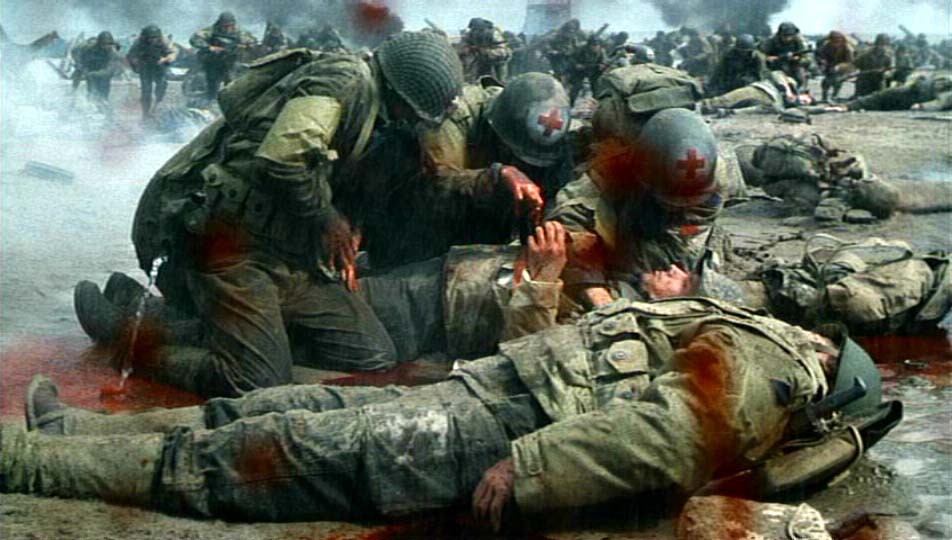
Scene from Saving Private Ryan.
The soldier as sacrificial victim.
 |
|
General Sir John Hacket: “The military makes demands which few if any other callings do. And of course emotionally disturbed people talk about being trained to kill.
"The whole essence of being a soldier is not to slay but to be slain. You offer yourself up to be slain, rather than setting yourself as a slayer. Now one can get into very deep water here, but there’s food for thought in it.”
The fundamental job of a soldier is to offer himself to be slain on the field of battle. The soldier's function is to become a sacrificial victim.
The perpetuation of warfare is based on the belief that sacrifice for one's nation is good and honorable. Soldiers are "chosen ones:" human beings who take on the burden of sacrifice. Their job is to devote their lives to their nation, and possibly to die for it.
Willingness to sacrifice one’s life for one’s country is the essence of national goodness. Wars give soldiers the opportunity to embody and demonstrate this goodness. The soldier symbolizes the sacrificed Christ, dying for all of us so that we may live.
Some people get off on the idea that young men are willing to give over their bodies and lives to a nation. People love the idea that men are dedicated and devoted. National glory is bound to the fact that men throughout history have "given their lives" for their country. Gravestones and monuments testify to our belief in the goodness of sacrificial death.
Warfare is conceived by the public in terms of honor and glory. The movie, Saving Private Ryan, reveals the abject state of being of the soldier. The soldiers at Omaha beach are the epitome of men who have "offered themselves to be slain," revealing that becoming a sacrificial victim is the essence of warfare. No sign of "male aggression" at Omaha Beach.
Soldiers drown as they try to reach shore, or are machine-gunned to death once they've reached shore. The film shows body parts floating in the water. Saving Private Ryan depicts the horrific nature of battle, war without sugar-coating. Yet people perceive the Second World War as a "good war.”
War is “good”—in spite of what happens to the soldier—when people conceive of the cause as good. The sacred ideology is what counts: more significant than the lives of individual human beings. |