|
|
|
Some of you asked if is there is a "permanent resting place" where you can find past issues of Library of Social Science Newsletters. But you may notice that the last Edition of the LSS Newsletter appearing in our Newsletter is dated February 22, 2019. Why? So: we need a New Webmaster to replace Orion: to handle the Newsletter as well as the Website. Nothing complicated at all--and most things can be handled virtually. You'll have the opportunity to become involved with some of the most significant ideas and greatest writers in the world. Below are some of our Newsletters as they appear in the LSS Newsletter archive. |
|
 The First World War as genocide (Feb 22, 2019)The model for mass-murder—the genocide of the Jews—evolved out of the First World War. Many nations systematically slaughtered their own people. Building upon this template, Hitler adopted one of its killing methods: poison gas. Hitler fulminated in Mein Kampf: "If at the beginning and during the War, 12 or 15 thousand of these Hebrew corrupters of the people had been held under poison gas, as happened to hundreds of thousands of our very best German workers in the field, the sacrifice of millions at the front would not have been in vain."
____________________________________________________________________________________
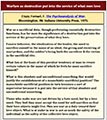 Destruction for the sake of love (Jan 23, 2019)War as a sacrificial duty, though performing essentially destructive functions, has for men the significance of a destruction put into the service of the preservation of what they love.Fanatic behavior, the idealization of the leader, the need to sacrifice oneself in the name of an ideal, the giving and receiving of martyrdom, and the soldier's being both the sacrificer & the victim in the sacrificial rite.
____________________________________________________________________________________ |
|
 Violence as sacred sacrifice (Jan 18, 2019) Drawing upon twenty-five article published on our Ideologies of War Website, Zhuo Job Chen takes this idea a step further hypothesizing that collective forms of violence give rise to the sacred object. Death itself is an absolute: "There is no higher purpose for dying than death itself." By dying, soldiers prove that there is "something worth dying for." Death creates the sacred object ex nihilo. _____________________________________________________________________________________________
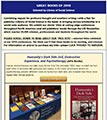 Great Books of 2018 (Jan 17, 2019).We exhibit clients' titles at cutting-edge conferences throughout North America—and sell publishers' books through the LSS Newsletter, which reaches 30,000 scholars, professionals and students throughout the world. PLEASE SCROLL DOWN TO READ ABOUT OUR "PICK HITS." We think you'll find these books exciting and relevant. For information on and/or to purchase any title—please CLICK THOUGH TO AMAZON.
______________________________________________________________________________
 Walls, borders, Psychogeography and boundary maintenance (Jan 11, 2019)Psychogeography is the study of how human beings construct boundaries to protect the nation and shore up the self; delineate inside from outside. How do personal boundaries come to be co-extensive with boundaries of the group? Why do nations “build walls” to defend citizens from “penetration” by alien outsiders? Howard Stein’s groundbreaking study. The world in which we now find ourselves is—characterized by a “frenzy of border protection (Paul Kahn).”
_____________________________________________________________________________
 The bodily source of ideology (Dec 12, 2018)The reality that the Nazis constructed cannot be separated from bodily fantasy. If ideas about a target domain are derived from experiences in a source domain, it follows that ideas about bodies politic cannot be separated from the experience of our own bodies. Social theory typically focuses on the ways that discourse shapes the body. I hypothesize that our bodies—bodily experience—give rise to and structures discourse.
_____________________________________________________________________________
 Building a Wall: Nationalism as Immunology (Dec 11, 2018)The American President equates his own body with the American body politic. He has presented a policy—that some people embrace—insisting that Americans protect their own "geographic space" (Stein, 2013). A wall is necessary in order to firm up "porous boundaries"—to prevent alien elements from seeping into the national body. _____________________________________________________________________________________________  The Human Body becomes a Body Politic (Dec 7, 2018)Hitler was an embodiment theorist. He insisted that Germany was a real entity, not merely an abstraction or "imagined community." His fantasy of Germany as a body crystallized at the Nuremberg rallies, which he created in order to perceive or "witness" the German body. At the moment people marched into the stadium and moved before him, Hitler's doubts about the reality of Germany vanished.
______________________________________________________________________________
 The Law of Sacrifice (Dec 4, 2018)The concept of "killing" is subordinate to the concept of "dying." The purpose of acts of "aggression" (killing in war, genocide or terrorism) is to get others to die for the idea that is worshiped by one's own group. A society kills members of another group—so that members of this group will be persuading of "the truth." Collective forms of violence are undertaken in order to establish the truth or validity of a sacred ideal.
______________________________________________________________________________ 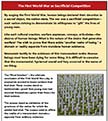 The First World War as Sacrificial Competition (Nov 13, 2018)Like each cultural creation, warfare expresses—the desires of human beings. What is the nature of the desire that generates warfare? The wish to prove that there exists “another realm of being,” a domain of reality separate from mundane human existence. Memorials testify to the existence of this transcendent realm. Human beings must have been dying for some thing. It is difficult to conceive that the monumental, hysterical sound and fury occurred in the name of no-thing.
_______________________________________________________________________________________________
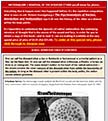 Nationalism = removal of the diseased other (Nov 1, 2018)One can call the diseased other a Jew or Bolshevik, a homosexual, mental patient or a Slav. Or one can call the diseased other a Mexican, Muslim, Syrian, an Arab or an immigrant. The name doesn't matter: in the heart of the radical nationalist—the dream remains the same: removal of the diseased other from within the boundaries of the nation. As long as the diseased other is present within the body politic, the nation cannot achieve greatness. ______________________________________________________________________________________________
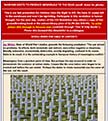 Warfare produces memorials to the dead (Oct 30, 2018)Jay Winter, Dean of World War I studies, presents the following conclusion: "The war solved no problems. Its effects, both immediate and indirect, were either negative or disastrous. Morally subversive, economically destructive, socially degrading, confused in its course, futile in its result it is the outstanding example in European history of meaningless conflict." Meaningless from a practical point of view. But perhaps the war occurred to demonstrate the existence of nation-states. Crosses were erected well before the war ended. Perhaps the desire to create memorials was the cause of the war, not the result.
_______________________________________________________________________________________________
|