|
|||
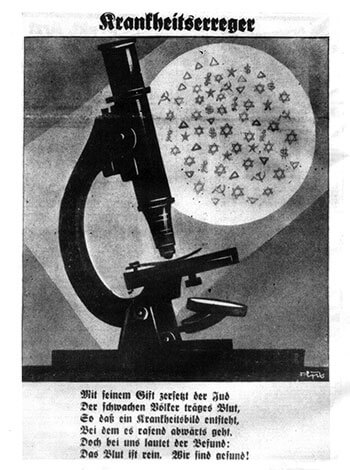
By being transformed into a societal discourse or ideology, energies and passions bound to a fantasy are released for action. The ideology transforms latent desires into a collective will to act. The will to act is generated by the desire to actualize the fantasy contained within the ideology. The role of the leader is to bring forth latent desires and fantasies, to create ideology that allows them to be shared—and to devise ways to actualize these fantasies. The Final Solution enacted a shared fantasy. What was the purpose of the Final Solution—the extermination of the Jewish people? What motivated Hitler and the Nazis to bring such an extraordinary form of behavior into being? If exterminating Jews was the Final Solution, was the "problem" that required killing Jews as the solution to the problem? The problem the Nazis sought to solve was the problem of death. The objective of the Final Solution was to remove the cause of death from within the body politic. The cause of death was Jews-—Jewish bacteria. Killing Jews was killing the cause of death. At stake was the survival of Germany. Hitler and the Nazis did not wish to have the specter of the Jewish disease hanging over their heads. Better to devise a solution that would eliminate this threat once and for all—a final solution. The Nazis invented the death camps—a massive societal institution—as a manic, hysterical struggle to kill the cause of death. Hitler’s Nazi ideology revolved around the idea of Germany as an enormous body (politic) suffering from a disease that could prove fatal. As the nation's leader, Hitler conceived his role as the one who could diagnose and cure Germany’s disease. Hitler’s insight was that Germany had been invaded by Jews—pathogenic microorganisms (bacteria, viruses and parasites). Curing Germany’s disease required removing these pathogenic organisms—source of the nation's disease—from within the body politic. The Final Solution required that every single Jew in the world be destroyed. This was because—in the Nazi fantasy—Jews were equated with pathogenic microorganisms. If even a single bacterium or virus remained, it would multiply and divide—and the disease would persist. Cure required that each and every Jew on the planet be killed. German ideology insisted that the world had to become “Jew free.” The Final Solution was a grotesque, monumental project to destroy the source of death. If there were no Jews in the world, according to Hitler’s fantasy, Germany could live forever. Hitler presented this ideological fantasy in his speeches. He was exquisitely "tuned in" to the fantasy--it was his own fantasy--and conveyed it with profound emotion. By virtue of the passion with which he conveyed his ideas, Hitler was able to evoke similar passion in others. His excitement was contagious. The phrases and images that excited him—excited the German people. At first, the results were exhilarating—the exhilaration of millions of people discovering they were united by the same dream. in Constitutional Law of the Third Reich (1935), Nazi political theorist Ernst Rudolf Huber, stated that the Führer was the "bearer of the collective will of the people." In the will of the leader, Huber said, the "will of the people is realized." Hitler's will was not the "subjective will of a single man." Rather, the "collective national will" was embodied within the leader. A people's collective will, Huber explained, is rooted in the "political idea which is given to a people." The political idea is present in the people, but the Führer "raises it to consciousness and discloses it." The leader functions to make manifest ideas and desires that had been latent. His ideology reveals and crystallizes a people's fantasies. Hitler invented images, metaphors and phrases to convey Nazi ideology, processing his own desires and fantasies and presenting them to his audience in the form of a societal discourse. After all was said in done—when he knew the war had been lost—Hitler never abandoned the fantasy that had motivated him from the beginning. The Final Solution, Hitler believed, was his greatest accomplishment. The Testament of Adolf Hitler: The Hitler-Bormann Documents: February-April 1945 was dictated to Martin Bormann. In an entry dated February 13, 1945, Hitler said: National Socialism has tackled the Jewish problem by action and not by words. For us, this has been an essential process of disinfection. We have lanced the Jewish abscess; and the world of the future will be eternally grateful to us. |