|
||||
|
Abstract: Ostensibly a war of aggression and conquest, the Nazi narrative from the months preceding the beginning of the war in September 1939 until Hitler’s last days in the Bunker in Berlin, presented the war and intent to exterminate European Jewry as a “war of defense against an act of aggression launched by an immensely powerful international Jewish conspiracy.” According to this narrative, Jewry was all powerful; Germany the innocent victim. Hitler imagined that he was engaged in a “life against death struggle:” either Germany would exterminate the Jews or the Jews would exterminate Germany. |
||||
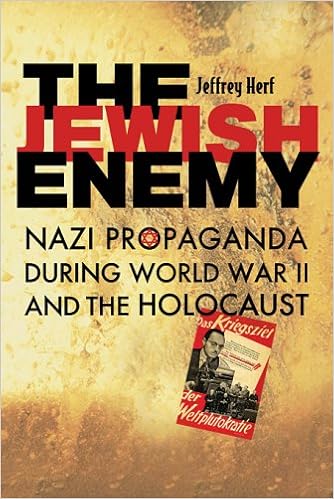
We now are beginning to understand that the Holocaust and World War II were not separate events. When the Nazi leadership, in private conversations, office memos, or public statements, drew a connection between the Jews and World War II, they were referring to the Holocaust and war “taken together as one apocalyptic battle.” The Final Solution was described by Lucy Dawidowicz (2010) as a “war against the Jews.” However, Herf notes, the Nazis did not limit the meaning of their war against “International Jewry” to the Final Solution. Rather, they viewed the Final Solution as a “necessary campaign of retaliation" in the context of a broader war of defense waged against international Jewry, world Jewry, and ‘the Jews’.” In the minds and public assertions of the Nazi leaders, they were fighting a single war that “pitted Germany and its allies against a colossal, international conspiracy” driven by “Jewish figures working behind the scenes.” The Allies were the “public facade” of this Jewish enemy. The Nazi’s narrative attributed enormous autonomy and power to the Jews, while “denying autonomy and power to the nominal leaders of the most powerful nations in the world,” Franklin Roosevelt. Winston Churchill, and Joseph Stalin, who were identifies as the Jews’ “puppets, accomplices, stooges and servants.” Saul Friedlander (2010) discusses Hitler’s “redemptive anti-Semitism,” which combined “paranoid fantasy about an all-powerful international Jewry" with promises of "redeeming and saving Germany from that pernicious influence.” The war against the Jews, in short, constituted a “rescue fantasy:” if Germany was to live, Jews had to die. Accounts of the power and influence wielded by Jews has been grossly misleading. According to the census of June 16, 1933, the Jewish population of Germany was approximately 505,000 people out of a total population of 67 million, less than 0.75 percent. In the central forum of political representation, the Reichstag, Jews were significantly under-represented. Of the 577 members of parliament elected in September 14, 1930, 17 were of Jews origin; of the 608 members elected on July 31, 1932, 14 were of Jewish origin. The conspiratorial notion of vast Jewish power, Herf concludes, had “no factual basis.” Radical anti-Semitism rested on the belief that the Jews were a “cohesive, politically active subject,” a group united on a global scale by racial bonds that “transcended any allegiance to nation-states.” In the Nazi view, this powerful and autonomous entity, international Jewry, “controlled assorted stooges and accomplices who served its evil interest.” If not identified and destroyed, the Nazis feared, “Jewry would annihilate the German people.” This was the paradox of the World War that was waged by Hitler and the Nazis. Ostensibly a war of aggression and conquest, the Nazi narrative from the months preceding the beginning of the war in September 1939 up until Hitler’s last days in the Bunker in Berlin, presented the war and intent to exterminate European Jewry as a “war of defense against an act of aggression launched by an immensely powerful international Jewish conspiracy.” According to this narrative, Jewry was all powerful; Germany was the innocent victim. Hitler imagined that he was engaged in a “life against death struggle:” either Germany would exterminate the Jews or the Jews would exterminate Germany. |