| Something to kill & die for/nothing to kill and die for Richard A. Koenigsberg |
||||
|
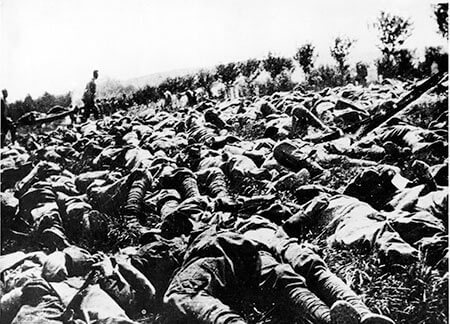
Which soldiers, in the photo below, were on the "winning" side and which on the losing side? From a theoretical point of view, does it matter? Paul Kahn observes that soldiers on each side died a terrible death for the sake of "making present sovereign power." Dead and mutilated soldiers testify to the fact that they died for some thing. Something to kill and die for. Doesn't matter what this thing is. The thing that people kill and die for might be a King, an Emperor, a nation, a god, or an ideology. Doesn't matter. The dead bodies that you see below prove that there is something "up above" in the name of which soldiers "gave their lives." Biological aggression? Nonsense. Nothing more spiritual than the institution of warfare. |
||||
From Paul H. Kahn, Sacred Violence “The battlefield is strewn with the disemboweled and beheaded, with severed limbs and broken bodies. All have died a terrible death in a display of sovereign power. Viewing the battlefield from a certain distance, it is not even clear who is the object of sacrifice: the enemy and the conscript suffer the same threat and burden of physical destruction for the sake of making present sovereign power.” |