| Hobbes, Thomas (1651). Leviathan.
|
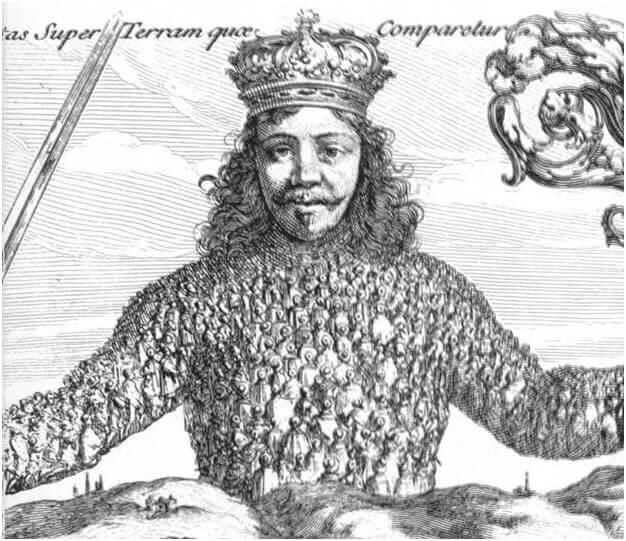
| The soverign’s torso and arms are composed of tiny individual persons, crowded closely together and each looking toward the head of the composite Leviathan. |
|
The highest realization of the self, according to the ideology that generated Japan’s participation in the Second World War (Skya, 2009), occurred when the individual “absorbed the self into the emperor;” when subjects “cast aside their individual selves and entered into the Emperor” (see image from Leviathan to the right).
The armed forces occupied a special position among the Emperor’s subjects. A passage from the Imperial Rescript to the Armed Forces read:
Soldiers and Sailors, we are your supreme commander in chief.
Our relations with you will be the
most intimate when We rely upon
you as Our limbs and you look up to
Us as your head.
The Japanese sovereign consisted of the Emperor as head, and his soldiers as parts of his body (see image from Leviathan above).
“Obedience to authority” is not an abstract concept, rather grows out of a grotesque psychosomatic fantasy whereby soldiers are imagined to be part of the sovereign—parts of his body.
The concept of "male aggression" as an explanation of male behavior in warfare is inadequate or superficial, if not bizarre. What is this male aggression? Where does the "aggression" come from?
It is rooted in--derives from--the fact that the "warrior" is required to submit to the leader or sovereign. The soldier is the leader's "limb." The limb of body is subject to the "head" of the leader; cannot resist or refuse the the will of the leader.
The Hobbes image conveys the idea of male bodies as part of the body of the sovereign. The tiny male bodies are fused with the body of a gigantic sovereign. How can any of these tiny bodies resist the will of the sovereign? They arepart of the sovereign's body. These bodies are in a state of paralysis.
The term that characterizes the behavior of the Japanese soldier best is masochistic submission. Doesn't this phrase, actually, accurately characterize the psychic position of any soldier who is asked to go into battle and to "die for his country?"
Of course, we don't say this. We represent soldiers as virile heroes. By doing so, as Carolyn Marvin says, we are able to "kill them more easily."
|