|
Abstract: Perhaps the ruthlessness and monumental scope of the Nazi’s extermination project reflected their conception of the genocide from the perspective of immunology. Ronald Glasser (1976) notes that our battles against microbes have "never been a war of percentages." Every microbe that enters our body, Glasser explains, has to be destroyed, not 98% of them or 99, but 100%. It has to be "total war; not one single enemy can be left alive." Just one survivor, by continuing to grow, would eventually mean death, and "so all have to be eliminated."
_____________________________________________________________________________
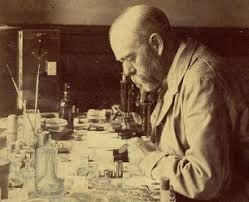
One of the most important influences on the thinking of Adolf Hitler was Robert Koch, who presented his discovery of the bacterium that causes tuberculosis on March 24, 1882. This led to widespread adulation of Koch—and the development of "bacteriology"— whose basic message was that each disease is caused by a specific pathogen. If one could identify and isolate the pathogenic organism for any given disease--and destroy it—the disease would be cured.
Genocide grew out of this idea--that each disease is caused by a specific pathogen, and that if one could identify the pathogen for a given disease and destroy it, the disease would be cured.
Hitler believed that Germany was suffering from a disease, and identified Jews as the cause. Jews were the "pathogenic organisms" responsible for Germany's disease, just as there was a bacterium responsible for tuberculosis.
Hitler insisted that Jews were responsible for the "disease within the body of the people." Genocide was undertaken as the vehicle toward cure. Germany would recover from her disease if Jews were removed from within the body politic. This medical theory was the source of the Holocaust.
Robert N. Proctor (1988) states that Hitler was celebrated as the "great doctor" of German society and as the "Robert Koch of politics" On the evening of February 22, 1942, Hitler met with Himmler and a Danish SS major and expounded his conviction that the discovery of the Jewish virus was "one of the greatest revolutions that has taken place in the world."
The battle in which we are engaged today, Hitler said, is "of the same sort as the battle waged, during the last century, by Pasteur and Koch. How many diseases have their origin in the Jewish virus! We shall regain our health only by eliminating the Jew." Hitler concludes: "Everything has a cause; nothing comes by chance."
At the Wansee Conference in 1942, Nazi chief Reinhardt Heydrich and other high-ranking Nazi officials met to determine the fate of 11 million European Jews. Their files contained voluminous statistics on the precise number of Jews in each country under Nazi occupation. With fanatic determination, they plotted to kill every single Jew in each of these countries.
Immunologist Ronald Glasser (1976) notes that our battles against microbes have "never been a war of percentages." Every microbe that enters our body, Glasser explains, has to be destroyed, not 98% of them or 99, but 100%. It has to be "total war; not one single enemy can be left alive." Just one survivor, by continuing to grow, would eventually mean death, and "so all have to be eliminated."
Perhaps the ruthlessness and monumental scope of the Nazi’s destructiveness reflected their conception of the genocidal project from the perspective of immunology. It was necessary to wage "total war" against the Jews--so that "not one single enemy would be left alive." Given the equation of Jews with bacteria, it followed that if even a single Jew survived, the bacterium would begin again to multiply and divide, thus spelling death for Germany.
The Nazi revolution was a medical revolution. Hitler imagined he had discovered the "Jewish virus" as the source of Germany's problems, indeed, as the source of the world's problems. He set in motion the Final Solution--to eliminate the source of the world's disease.
|