|
The danger of Western existence is overvaluating the mechanism of projective identification, whereby the self is projected into ideas and objects in social reality. Western man tends to equate himself with symbols of the self that the self has created.
In nationalism and other ideologies, for example, we observe the tendency of the self to equate its self with ideas thought more significant than concrete human beings, ideas that often cause individuals to negate themselves--even to die supporting and defending omnipotent symbols of the self.
 Western man idealizes creativity and productivity, more accurately the objects created and produced as a result of activity. Often, the desire to create and produce becomes a compulsion: The self so idealizes the fruits of action, so identifies with the wondrous objects which have been created, that the self-forgets its own existence; and forgets living in the name of creating. Energy is expended externalizing the self into objects, with subsequent diminished cathexis of the self.
Western man often is in danger of being consumed by his creations; of sacrificing existence in the name of objects testifying to existence. Life is defined as the process of production; of creating and producing objects that can be witnessed and used by others. Life is equated with the process of externalizing the self into objects.
Western man comes into being as he creates objects testifying to and justify his existence. The externalization of the self into things confirms the reality of the existor. The danger is that, in his hysterical activity, Western forgets the source of creation and devalues the existor in the name of the objects he has created.
Life becomes a sacrifice: the self bows down and worships its own creations. The ego becomes masochistic, devaluing itself, conceiving itself only as an ego-in-fusion, defined by external symbols to which the self feels connected. The mechanism of identifying the self with "omnipotent" objects may be described as splitting: the self "splits off" a part of its self and projects its sense of reality into an idea or object outside the self.
What is "real" is not the process of existence nor the consciousness of being, but the objects created by the being. The reality of the self becomes projectively identified with an object symbolizing the self. Existence has been sacrificed in the name of objects.
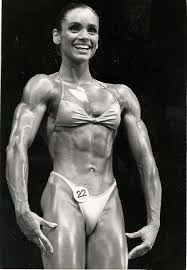
I wish to focus in this essay on body-building and other modes of athletic activity as a change process whose purpose is to relocate the self in concrete existence and withdrawing libido from "omnipotent" ideals and objects that had come to stand for the self.
In projective identification, the ego "splits" into two: a part of the self- relocates into an idea or object which is mentally represented as external to the self. Body-building has the purpose of annulling projective identification, disavowing the tendency of the ego to externalize itself. In body-building, the self seeks to return to the physical source of the ego; to return to the body as a unified, integral self; the body before the self externalized its self and split into two.
Body-building represents an effort to reclaim libido for concrete existence; to prevent libido from being "drained off" into culture. Creativity and productivity may reflect a tendency toward self-castration--in that the displacement of libido into objects testifying to the existence of the self may drain the self of its own cathexis. The experience of concrete existence is negated as the expends libido externalizing the self into symbols of the self.
The "phallic phase" means a focus upon the organ of reproduction: The ego is reproduced, duplicated (like a Xerox copy) in objects that symbolize the ego and testify to the self's existence. Body-building is a defense against the phallic phase, an attempt to cathect the entire organism--symbolizing of the unity of the self.
The phallic phase seeks to externalize the ego to create "hard objects" that do not disintegrate as quickly as the human body; objects which will "live on." Body-building seeks to return to the source of existence (the place at which life and death actually occurs), to relocate existence within the concrete experience of one's own muscles.
The "physical fitness revolution" (which began in approximately 1977) manifested disillusionment with culture and social life as a source of stability and an effort to find a new place of stability--by locating the self in a place from which it cannot be separated. Ideas come and go, relationships occur and dissolve, one may live in place and then another, but one's body is present wherever one is.
Focusing on the body means that the self is unified with its self: You exist where you are, as a unity, and cannot be separated from your self because the core of self is one's body. Body-building means that the self is no longer located in an idea, diffused throughout the social world: The self is contained within the musculature. The experience of the muscle-system binds the self closely to its self.
Long-distance running, like body-building, represents a concentration of the self and libido within a narrow sphere of reality; the physical space in which muscles are exerting an effort. George Sheehan, in Running and Being, describes how he rediscovered his self in his body; how he "scraped away" the illusions of social existence to discover the undeniable core of being in physical effort and physical experience.
He describes the immense pleasure of the "loneliness of the long-distance runner"--where the self comes to experience its self as a solitary, unified entity, as an integer, no longer confused or contaminated by the demands of social reality or distortions of socialized existence.
What appears to have occurred, for Sheehan, is that the intensity of proprioceptive stimulation, the amount of energy and effort required to run, made it impossible for the self to escape the concrete experience of its own existence.
The task of running a long distance is so arduous and all-consuming--so entirely experiential--that conceptions of existence, images and fantasies about the self drop away. One is unable to think about the past or dream about the future. Rather, the totality of the self and its libido must be concentrated within the body and brought to bear upon the task at hand.
By contracting existence, focusing all psychic energy within a single space (the space of one's body) and on a single task, one intensifies existence, overcomes the tendency toward fantasy and mental diffuseness. The athletic experience permits the individual to drop the dream or idea of existence (existence as a "social construction") and to equate existence with the inescapable presence and unity of one's own body and will.
|