|
Koenigsberg defines psychoanalytic sociology as a science whose objective is to identify the psychological roots of cultural ideas and beliefs, particularly those embodied in modern ideologies. Whereas conventional social theory often is satisfied with “discourse” as an explanatory concept, Koenigsberg explores the unconscious desires and fantasies that are the source of cultural narratives.
Hitler’s Ideology is the “go to book” for research on the psychological meaning of culture, ideology and history, an invaluable resource for historians, sociologists, anthropologists and psychoanalysts.
Please order immediately to make certain you obtain your copy Available now as an ebook. Click here for information.
Brilliant and fascinating: Koenigsberg's work is so insightful that it should be required reading in the education of everyone in the civilized world.
—Joe E. Wyatt, Society of Modern Psychoanalysis |
|
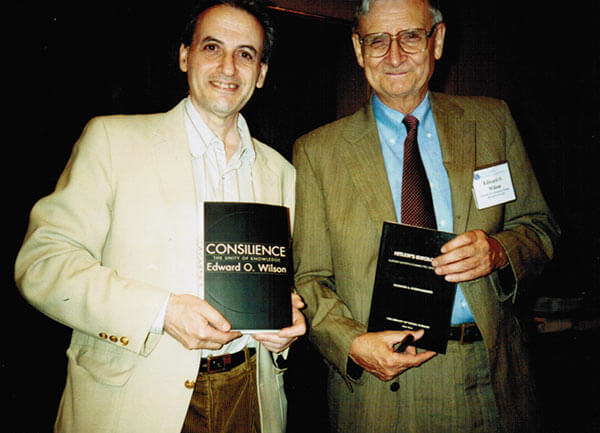 |
| Edward O. Wilson, Father of Sociobiology (holding Koenigsberg’s Hitler’s Ideology), and Richard Koenigsberg (Father of Psychoanalytic Sociology) holding Wilson’s Consilience. |
This work deserves to be an instant classic. With care and caution, Koenigsberg remains close to the data from which he adduces his theory. Koenigsberg suggests that what is at stake is larger than an explanation of Hitler, Nazism, or even nationalism: it is, rather, an explanation of culture itself. Koenigsberg's genius has unlocked many of the unconscious secrets of a timeless drama.
—Howard F. Stein, Journal of Psychoanalytic Anthropology |
The best critical analysis in English of Hitler's thought.
—Colin Day |
Presents an ingenious technique for identifying the psychological origins of political and social events.
—The Village Voice |
An imaginative and important work.
—Robert G. L Waite, author, The Psychopathic God: Adolf Hitler |
|
|
|
Hitler's Ideology: A Study in Psychoanalytic Sociology
Richard A. Koenigsberg
Table of Contents
Preface
List of Tables
Abbreviations of Works Most Frequently Cited
PART ONE: IDEOLOGY AND PHANTASY
Introduction
Chapter I: Hitler's Ideology
- Destructive Forces in the National Body
- The Source of Destructive Forces
- The Struggle Against Submission
- The Union of Austria and Germany
- The Individual and the Nation
- Conclusions: the Psychological Meaning of Hitler's Ideology
Chapter II: The Death of Hitler's Mother
- The National Body = Hitler's Dying Mother
- The Denial of Death
- Reality and Unconscious Phantasy
- Summary and Conclusions
PART TWO: SOCIAL BEHAVIOR
Chapter III: Anti-Semitism
- The Maintenance of the "Goodness" of the German People
- "Separating out" the Jew
- Psychodynamics
Chapter IV: War
- War as a Struggle Against Death
- "Protecting the Rear"
- The Need for Territory
- Summary: Motives for War
PART THREE: THEORY
Chapter V: Ideology and Phantasy
Chapter VI: Nationalism
- Introduction
- The Nationalist Ideology
- The Denial of Separateness
- Serving the Country = Serving the Mother
- The Country as a Projection of Infantile Narcissism
- "Save the Country"
- The Maintenance of the "Goodness" of the Nation
- Summary and Conclusions
Appendix
Bibliography
Index |