In the previous LSS Newsletter, I reported receiving the following note from Professor Ivan Strenski--when I asked him if his theories of SACRIFICE might be relevant to the current political situation:
Perhaps we need to be posing a question about the US gov’s COVID policy within the framwork of the concept of sacrifice: the other day, an administration leader said taking precautions vs Covid was useless, since everyone was going to get it anyway. Viewed in the light of sacrifice, is the administration admitting “sacrificing” the collective health of the nation? And, if it is “giving up” these lives in sacrifice, Cui Bono (to whom is it a benefit)? For whom or what is it sacrificing our lives? For Many of us the cruel answer Is all too obvious. We’re being sacrificed on the altar of political and personal ambition. The government is giving us up for sacrificial slaughter.
My response to Ivan was accompanied by an LSS NEWSLETTER (see directly below): "MASS-MURDER AS THE BEDROCK OF HISTORY: I Kill therefore I Am."
Thank you Ivan, I think we can understand COVID in the United States within the framework of the concept of sacrifice: “giving up,” sacrificing the collective health of Americans. But for whom or what is this sacrifice taking place? What is the nature of the altar upon which sacrifice is occurring? What is the nature of the political ambition? We need to place what is occurring today within a broader historical framework.
The paradox to consider is that the death of human beings within a nation is not necessarily considered a bad thing.
Who are among the most remembered men in history (see below)? Napoleon, Hitler, Stalin and Mao. What are they primarily remembered for? The number of people that died under their watch. The ambition of a person who seeks to “make history” is "to be remembered.” Although the Covid virus came as a surprise, the 186,000 Americans that have died so far may be conceived as sacrificial deaths.
You and I have observed that dying for a nation or religion (sacrificial death) is often conceived as a good thing.
The key ambition for leader who seek to "make history" is to be remembered. And one of the primary ways a leader is remembered is by virtue of the number of human beings who have died under his watch.
Best regards, Richard
________________________________________________________________________________________________________________________________________________
Ivan responded with an email, Qualifications and distinctions---Strenski, COVID and sacrificial death
Dear Richard and Colleagues,
I think we are at risk of some misunderstandings. Two propositions matter to this issue: (1) Stalin, Hitler, Napoleon are remembered (2) They are responsible for the deaths of many people.
But these propositions require unpacking. Re: (1) “remembered:” but how rememberered— "celebrated” or “infamous?” Clearly, in the cases of Stalin, Hitler, Napoleon and their ilk, they might be celebrated for having killed so many ENEMY. Yet at the same time, they are infamous for having LOST many their own fighters. Political propaganda is designed to make us remember ONE sense of memory, and to forget others. They killed lots of the enemy. But Stalin, Hitler, Napoleon are NOT celebrated for the deaths of their own fighters. Those numbers are suppressed in favor of enemy death tolls.
Thus I do not recall evidence for recalling that Stalin, Hitler, Napoleon are celebrated for the casualties their forces sustained — or if one prefers — for the size of the sacrifice they required of the nation. Those numbers are suppressed in nationalist discourse. A simple thought-experiment shows why. Imagine that Stalin, Hitler, Napoleon would have won the same victories, but lost 1/2 for 3/4 of the lives of their fellow citizens AND that it could be proven. Certainly, they would be celebrated even MORE for doing so, not less.
This is why Trump seeks to be remembered (celebrated) for the loss of 180k American COVID death — BECAUSE by comparison (so he claims) so many MORE wold have died. Also typical of Trump's discourse about COVID deaths is the ABSENCE of describing them as sacrifices. To have done so would have meant solemnizing these deaths — and therefore SHARING in the feelings of the families of those killed by COVID, for whom the dead are sacred. But, of course, Trump is essentially devoid of all feelings of sympathy or empathy, especially for those who have suffered loss.
They’re LOSERS after all. And, we all know what Trump thinks of losers. Moreover, to think of COVID deaths as sacrifices would imply imagining them as serving some noble purpose. But characteristic of Trump’s approach to COVID has been to have NO PLAN. Social Darwinist that he is, only the FIT will survive — one they really deserve to survive. The ‘winners” will survive, “losers” will not. “It is what it is,” Trump says again. By NOT wearing a mask, he even flaunts his winner’s status. Ivan
_____________________________________________________________________________________________________________________________________________
In the next issue of the LSS Newsletter, I will counter Ivan's argument, drawing upon his own essay, "SACRIFICE: BAD MATH, BAD GRAMMAR," in which he observes that a "dilemma sits at the center of sacrificial discourse." Sacrifice, he says, means loss, giving up, destruction and death. But "much talk about sacrifice carries on as if this loss, this substraction actually achieves addition."
Soldiers sacrifice themselves in battle, but "this doesn't count as diminishment." It actually "adds to whatever social body of reference is in play."
Strenski poses a fundamental question: "Why and how can sacrifice add to the social whole, when, in the fact of destruction and death, it "subtracts from the social whole by removing one of its members from the body of the living?"
In short, how does it come to be that LOSS = GAIN.
RAK
|
MASS-MURDER AS THE BEDROCK OF HISTORY:
“I kill, therefore I am.”
Abstract: “History” records the acts of political leaders who have killed a lot of people. Historical significance is measured by counting skulls. Napoleon, Hitler, Stalin and Mao (see photos below) are chronicled because they produced a monumental number of cripples and corpses.
|
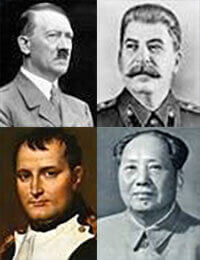
Which historical figure produced the most corpses? |
|
Terrorist philosopher Ali Benhadj stated that if a faith is not watered or irrigated by blood it “does not grow.” A belief needs to be reinforced by “sacrifices, suicide operations and martyrdom.”
Saddam Hussein called history a “record of sacrifices made in blood.” History is elevated to the status of belief when “sacred blood is shed in the most crucial situations.”
According to Islamic revolutionary Abdullah Azzam, history “does not write its lines except with blood.” Glory does not build its lofty edifice “except with skulls.” Honor and respect are established on a foundation of “cripples and corpses.”
“History” records the acts of political leaders who have killed a lot of people. Historical “significance” is measured by “counting skulls.” Napoleon, Hitler, Stalin and Mao are chronicled because they produced a monumental number of cripples and corpses.
As these leaders murdered millions of people, they may have reflected (winking to future historians), “I kill, therefore I am.” |
|