|
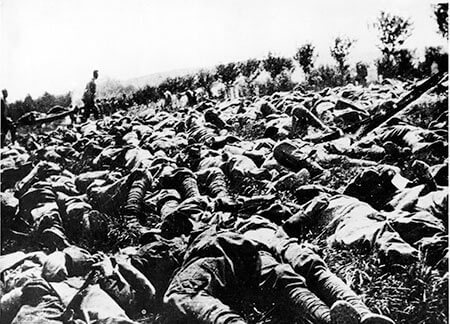
Paul Kahn, one of our greatest theorists of collective violence, also is clear that the essence of warfare is not "victory" or "defeat," rather revolves around the generation or production of dead bodies (Strenski: loss = gain). As Kahn points out, if one views a battlefield from a distance, it is "not clear who is the object of sacrifice:" The enemy and conscript "suffer the same fate."
The image below is of a First World War Battlefield, but it could be a photo of any battlefield. There are a multitude of "reasons." Each war has it's own "reasons." However, the final result, or "final solution" if you wish, is that the bodies of young men are strewn on a battlefield.
Hitler understood war better than nearly every historian. He decided that it was possible to produce dead bodies without waging war. "Go directly to jail. Do not pass go. Do not collect $200." He would simply kill a large number of people--in the most effective way possible.
His thinking was as follows: "If society does not criticize me for sending my own young men to die in battle, why should society criticize me if I send the enemy of the German people to their deaths?"
The Holocaust was a satire of war; a reductio ad absurdum."
|