|
The day after Daniel Goldhagen's presentation, I spoke on The Sacrificial Meaning of the Holocaust.
50 million people or more died as a result of the violence that Hitler unleashed. What Nazism came down to—after all is said and done—was "Die, or we will kill you."
One can speak about conquest, or living space, or whatever—until one is blue in the face—trying to persuade oneself that Hitler had "rational" objectives. The reality is that the Hitler's primary object was...mass-murder.
Historians attempt to persuade themselves that the dying and killing that occurred during the Nazi era was in the service of attempting to achieve something. Wouldn't it be more parsimonious to hypothesize that the murder or death of as many people as possible--was what Hitler wished to achieve?
At the core of Hitler's ideology was the idea that it is noble for human beings to sacrifice their lives for a nation. The idea was not, "Sacrifice your life in order to achieve such-and-such." The idea was that sacrifice is good per se. Sacrificial death was the summum bonum.
The opposite of willingness to sacrifice is unwillingness to sacrifice. This is what Jews symbolized for Hitler: unwillingness to sacrifice one’s life for a nation-state. More precisely, Hitler believed Jews were incapable of sacrificing for a nation. This character flaw was genetically given. As a result of their biological nature, Jews could not be reformed.
Declared war on September 1, 1939—speaking before the Reichstag as German planes and troops crossed the Polish borders in a devastating Blitzkrieg—Hitler proclaimed:
As a National Socialist and a German soldier, I enter upon this fight with a stout heart! My whole life has been but one continuous struggle for my people, and that whole struggle has been inspired by one single conviction: Faith in my people!
I ask of every German what I myself am prepared to do at any moment: to be ready to lay down his life for his people and for his country. If anyone thinks that he can evade this national duty directly or indirectly, he will perish.
This passage tells us much of what we need to know about Hitler's thinking--as he embarked on World War:
- Hitler asks his people to lay down their lives for Germany.
- He states that he is ready to do the same: to lay down his life for his people.
- He states that if anyone thinks he can "evade their national duty" (to lay down one’s life), he would "perish."
On the first proposition, Hitler was true to his word. The precise number is difficult to determine, but a reliable source estimates that over 7 million Germans died in the Second World War. Due to Hitler's refusal to surrender, over half of those who died (54%) were civilians.
Hitler's second prophecy—his willingness to lay down his own life—was fulfilled. As the war was ending, he committed suicide.
The third prophecy is the most interesting. Hitler declared that anyone who thought he could "Evade their national duty"—to lay down one’s life for Germany—would "perish."
This is why Jews had to die. Since they were incapable of voluntarily sacrificing their lives for a nation-state, they would be compelled to do so. No one would be permitted to evade the sacrificial imperative—not even Jews.
Hitler's ideology revolved around the idea that there would be no other god before Germany. He required that everyone bow down to the idol that he worshipped—initiating World War II as a massive sacrificial ritual.
German soldiers did not rebel against the requirement that they "lay down their lives." As his men went into battle against the Soviet Union in 1941, German General von Rundstedt admonished soldiers of the Second World War to emulate the examples of their brothers in the First World War and "to die in the same way—to be as strong, unswerving and obedient, to go happily and as a matter of course to his death."
But what about those German soldiers who attempted to "evade their national duty"—refused to perish for Germany?
Stephen Fritz notes that German soldiers suspected of desertion were often executed and left dangling from trees with placards around their necks that read "cowardice in the face of the enemy." Sixteen-year-old Hans-Rudolf Vilter never forgot the picture of chaos in Berlin in 1945, especially the deserters and apprehended soldiers that one saw hanging on lampposts and trees with the sign, “I hang here because I am too cowardly to defend my fatherland.”
In short, as the war continued, Hitler fulfilled the prophecy that he had made when he declared war on September 1, 1939. German soldiers who continued to fight would fulfill their duty by dying in battle.
Those who tried to evade their duty to die in battle would be hung, or shot. One soldier recalled that in the fall of 1944, armed German officers gave his unit no choice but to attack enemy lines, where it was likely they would be slaughtered. The other option was clear: be shot by your own leaders.
Units established special formations whose instructions were to "make immediate use of their weapon in order to enforce obedience and discipline." The situation in which many German soldiers found themselves, said Helmut Altner, himself a soldier, was devilishly simple: “There were only two possibilities: Death by a bullet from the enemy, or by the ‘thugs’ of the SS.”
Thus did Hitler fulfill his prophecy: an honorable soldier would fulfill his duty by dying for Germany. Or, attempting to evade this national duty, he would perish: shot by his own officers. |
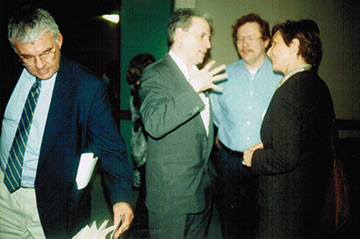 Conference Director Jack Fischel (left). Koenigsberg continuing his lecture—after his lecture.