|
|
|
Patrick Pearse was one of the most important political leaders of the early 20th century—founder of the Irish Revolutionary movement. He was thrilled by the carnage of the First World War: The last sixteen months have been the most glorious in the history of Europe. Heroism has come back to the earth. It is good for the world to be warmed with the red wine of the battlefield. Such august homage was never before offered to God as this—the homage of millions of lives given gladly for love of country. Like a revolutionary Islamic leader who trains young men to perform suicide bombings in the name of Allah--and is thrilled that these young men are willing to die for the cause--Pearse is thrilled that young men give their lives gladly for "love of country." There are differences between the case of Islamic radicalism (dying for Allah) and the case of the First World War (dying for France, Germany, Great Britain, etc.): (2) The magnitude of slaughter: Western leaders during the First World War sent many more men to their deaths than Islamic leaders. Islamicists could perform suicide operations for 50 years and they could never equal the "accomplishment" of Western political leaders--in terms of the number of men who "died for the cause" (see statistics below). Richard Koenigsberg |
|
|
White, Matthew — First World War Casualties Source: Historical Atlas of the Twentieth Century. 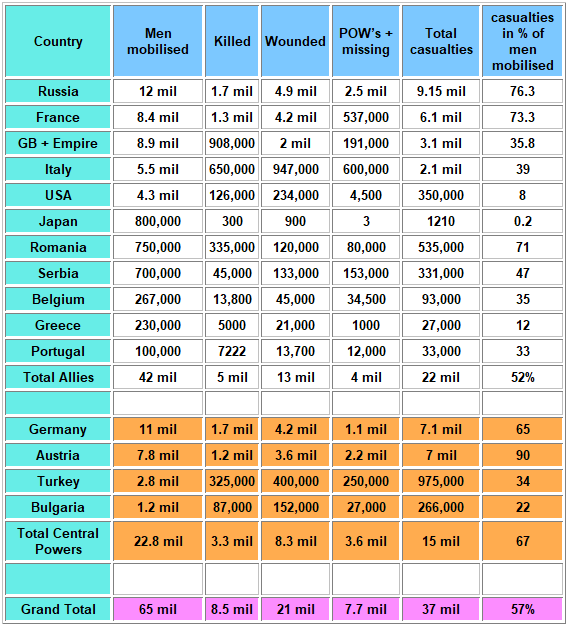 |