|
||||
|
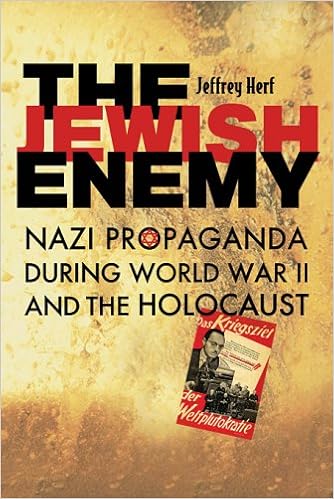
One of the delusions about the Holocaust is that the Nazis considered Jews an "inferior race," and therefore was bent on their destruction. As the excerpts below from an essay by Jeffrey Herf document, precisely the opposite was the case: the Nazis imagined "Jews" as an all-powerful group, united as if a single entity throughout the world. The all-powerful Jewish race was bent on exterminating Germany. Hitler waged war against the Soviet Union in order to exterminate Jewish-Bolsheviks before Jewish-Bolsheviks could exterminate Germany. Richard Koenigsberg |
||||
Excerpts from: "The 'Jewish War': Goebbels and the Antisemitic Campaigns of the Nazi Propaganda Ministry." Goebbels described Bolshevism as the Jews’ “declaration of battle” (Kampfansage) against culture. Bolshevism was calculated to bring about “the absolute destruction” (die absolute Vernichtung) of the accomplishments of the West (Abendlandes) in the interest of a “rootless and nomadic international clique of conspirators.” A small Jewish clique dominated the Soviet Union. National Socialism’s mission was to prevent the “Bolshevization of the world.” In fact, “the Bolshevik international” was “a Jewish international.” “International Jewry” was an existing historical subject that posed a threat to Europe and the West. Bolshevism was a threat because it served the interests of international Jewry that, in Hitler and Goebbels’s view, comprised the racial foundations on which communist theory and practice rested. In violation of the Munich agreements, Germany invaded and occupied most of Czechoslovakia on March 14, 1939. Now that Hitler’s plans for expansion were undeniable, Britain and France declared their willingness to defend Poland, should Germany invade. But in an April 1 essay titled “Wer will den Krieg?” (Who Wants War?), Goebbels offered a contrasting explanation of the sources of a new war. He wrote that all criticism of Nazi policy coming from Great Britain, the United States, and the Soviet Union was due to Jewish power. The Jews had “an interest in a war.” Jewish advisers surrounded Roosevelt. They were the anonymous power that stands behind everything. The Jews are guilty. If in a dark hour a war should break out again in Europe, the call must go out around the earth: the Jews are guilty! They want the war and they are doing everything in their power to push the peoples into war. They believe they won’t be victims but beneficiaries of such a war. That is why they fan this infernal witch-hunt against Germany and Italy and call for a fighting block of democratic against authoritarian states. With Operation Barbarossa, Goebbels and his propagandists renewed their offensive against “Jewish-Bolshevism.” In an article for Das Reich of July 20, 1941—a month following the invasion of the Soviet Union—Goebbels returned to familiar themes in the article “Mimikry.” The Jews, he wrote, were masters at adapting to surroundings “without losing their essence. They practice mimicry." One had to be “an experienced Jewish expert” to unmask them. Had the Nazis not come to power in Germany, “our country would be ripe for Bolshevism, the most devilish infection which Jewry can bring.” Were the Soviet Union to expand its power, the result would be the domination of Jewry over the world. After the leading circles of international Jewry had to realize that it was impossible to bring about the Bolshevization of the individual countries of Europe through the path of [political] agitation, they decided to wait for the great opportunity of a coming war, then chose their position so that the war lasted as long as possible. They did so in order to attack [and Bolshevize] an exhausted Europe at the end of the war. . . . The tactics of Moscow Bolshevism have been directed at this goal since the beginning of this war. The Soviets had tried to keep the “Jewish leaders” in the background and to convince the Germans that the Jewish Bolsheviks in Moscow and the Jewish plutocrats in London and Washington were deadly enemies. In fact [the Soviet Union, Great Britain, and the United States] 66 Holocaust and Genocide Studies drew ever closer to make the encircling grasp with which they wished to crush us ever stronger. Above all it is the same Jews, on both sides, whether open or camouflaged, who establish the tone and establish the line. When they pray in Moscow and go to London to sing the International, they are doing what they have done for ages. . . . They adapt to the respective conditions and situation and slowly, naturally, and step by step so that the peoples will not be suspicious and vigilant. They are naturally so furious with us because we unmask them. On December 1, 1941, Goebbels delivered a two-hour lecture to diplomats, government officials, party members, Wehrmacht officers, journalists, industrialists, and members of the Deutsche Akademie assembled in the main lecture hall of the Friedrich Wilhelm University of Berlin. It was published in pamphlet form as “Das Eherne Herz” (The Iron Heart). He called the invasion of the Soviet Union a necessary preemptive strike. If the Soviets had struck first, the Red Army’s “first task would have been to exterminate the national intelligentsia and the spiritual leadership of the nation.” Germany’s invasion was therefore a defense of culture and civilization. Britain and the United States were betraying Europe by leaving it to the mercy of Bolshevism. The Jews had launched and expanded the war but had miscalculated. In front of this elite audience Goebbels stated bluntly that Hitler’s prophecy was now being realized. The Jews were experiencing “a gradual process of extermination.” He used the noun “Vernichtung” to mean that the Soviet Union would have murdered masses of Germans; the Jews’ extermination might be “gradual,” but this sophisticated audience understood what the fulfillment of Hitler’s prophecy meant. “Der Krieg und die Juden” (The War and the Jews), published in Das Reich on May 9, 1943, was the third of Goebbels’s wartime essays devoted exclusively to the Jews. He expressed exasperation that there were still people who were too naive to understand what the war was about and what role the Jewish Question played in it. The “Jewish race” and its “helpers” were waging war against “Aryan humanity as well as against Western culture and civilization.” Jewry wanted this war. Wherever you look in the enemy camp, be it on the plutocratic or on the Bolshevistic side, one sees the Jews as inspirers and agitators working behind those exponents standing in the foreground. [The Jews] organize the enemy war economy and develop the programs for annihilation and extermination aimed at the Axis powers. It is from their ranks that the bloodthirsty, enraged, and revenge-seeking agitators and political wild men in England and the United States and the terrorist GPU commissars in the Soviet Union are recruited. Hence, they form the glue that holds the enemy coalition together. Even in the final months, Goebbels found in antisemitism the explanation for Nazi Germany’s impending defeat, abandoned—one might say “stabbed in the back”—by a West that had succumbed to Jewish domination. For the Nazi hardcore, World War II was ending as had World War I, with a noble Germany betrayed, perhaps this time not from within, but in any case from without at the hands of the Western Jewish-dominated “plutocracies.” If the Jews had not been allowed to exert their sway over policy in London and Washington, Nazi Germany could have won the war. In February 1945 Goebbels was still holding the Jews responsible for the Third Reich’s impending defeat. And as chroniclers of the death marches of spring 1945 have shown, widespread popular participation in Germany’s revenge against its relentless and soon-to-be victorious “foe” continued up to the very end. Social and intellectual historians have documented the fact that after the defeat in Stalingrad in February 1943, disillusionment and deradicalization spread in parts of German society.118 Hitler had turned out not to be an infallible genius. The master race was not winning the war. The international Jewish conspiracy never existed beyond the imaginations of the Nazi leaders. The army was clearly defeated on the battlefield. There was no second stab in the back. Yet for the Nazi hardcore and its leading propagandist, impending defeat reinforced the conviction that the international Jewish conspiracy did indeed exist. In the alliance between the Soviet Union, Great Britain, and the United States, it was about to win World War II. It is no wonder Victor Klemperer, among Goebbels’s most acute and perceptive listeners within Germany, wrote in his diary soon after D-Day that “however much I resisted it, the Jew is in every respect the center of [the language of the Third Reich] and of its whole view of the epoch.” My intent has been to give renewed attention to the main themes of the Nazi antisemitic narrative and to encourage a rethinking of the meaning of the now famous phrase, “the war against the Jews.” The antisemitic narrative in Goebbels’s articles and speeches, which reflected Hitler’s wishes and were repeated in other organs of Nazi propaganda, focused on the following central point: Nazi Germany was not fighting two separate wars, one against the nation-states of the anti-Hitler coalition and a second, separate “war” against the Jews. Rather, in their own imaginations World War II and the “Final Solution” were different aspects of one war fought between Nazi Germany, or “Aryan humanity,” on the one hand, and an international Jewish conspiracy on the other. While the Soviet Union, Great Britain, and the United States fought the war to defend their national interests, the Nazi leadership believed and publicly declared from its origins to its end that World War II was a war waged by international Jewry against Nazi Germany. Nazi propaganda presented the regime’s threats to exterminate the Jews as part of a policy of massive retaliation against those who had waged war against Germany. During the war years, as had been the case since the campaign to bring down the Weimar Republic, Nazi antisemitism was simultaneously an effective political instrument as well as, for its adherents, a powerful and simple framework of interpretation with which to make sense (or nonsense) of the course of events. |