|
SHARED PSYCHOTIC FANTASY = REALITY
|
|
Lee Harris: “What happens when it is not an individual who is caught up in his fantasy world, but an entire group — a sect, or a people, or even a nation?
|
|
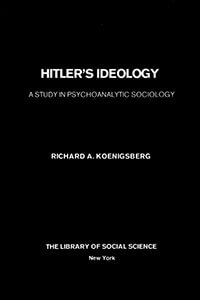
Author: Richard Koenigsberg
The best critical analysis in English of Hitler’s thought.—Colin Day
For information on order the ebook at a special rate, please click here.
|
ABOUT HITLER'S IDEOLOGY
Why did Hitler initiate the Final Solution and take Germany to war? Based on analysis of Hitler’s rhetoric—the words, images and metaphors contained within his writing and speeches—Koenigsberg reveals the “hidden narratives” that were the source of genocide. Hitler’s actions—the history he created—followed based on his fantasy that by destroying the Jewish “disease” Germany might live forever.
For information on order the ebook at a special rate, please click here.
|
- Shared fantasies produce psychic pathologies which, however, are not recognized as psychopathology because everyone shares or buys into them. The fantasies that define politics are contained within the ORDINARY STRUCTURES OF CULTURE. We shy away from conceiving of the normal historical process as a vast arena in which extraordinary forms of psychopathology occur.
- “ORDINARY” FORMS OF REALITY MAY GROW OUT OF PSYCHOTIC BELIEF SYSTEMS: Reality is constructed based on shared fantasy. The fact that a fantasy is shared leads us to believe that what is occurring is NOT psychotic, even though the results are monumentally destructive and self-destructive. The Nazis were suffering from a paranoid psychosis. However, when many persons in a society share and embrace a particular idea, we no longer call it a psychosis. Really, we have not yet developed a way of conceptualizing psychotic ideas that are shared by many members of a society.
- One might say that the Nazis were suffering from a paranoid psychosis. However, when many persons in a society share and embrace a particular idea, we no longer call it a psychosis. Really, we have not yet developed a way of conceptualizing psychotic ideas that are shared by many members of a society.
- RAK: We have difficulty imagining that an entire social movement or culture grew out of—was built upon—a fundamentally psychotic idea, that is, an idea that bore no relationship to reality. What’s more, that this psychotic idea led to a level of destructiveness that—if it occurred in a context other than the context of “war”—could be conceived as psychotic,
|
|
|
|
|