|
The ambition of civilized man is revealed in the pyramid--the achievement of the first modern individualists (scroll down to view the PYRAMID OF KHUFU). In the pyramid repose both the hope of immortality and the fruit of
compound interest. The Iron Age, at the end of which we live, democratized the achievements of the Bronze Age (cities, metals, money, writing) and opened up the pursuit of kings (money and immortality) to the average citizen.
But the inevitable irony redresses the balance in favor of death. Death is overcome on condition that the real actuality of life pass into these immortal and dead things; money is the man; the immortality of an estate or a corporation resides in the dead things which alone endure.
Civilized economic activity has this death-defying and deadening structure because economic activity is sustained by psychic energy taking the form of sublimation. All civilized sublimation, and not only the pursuit of money, has this structure.
Thus in the first of his odes Horace sees poetry as a career, like all careers (trader, soldier, athlete, etc.), basically characterized by self-sacrifice and instinctual renunciation; it is nevertheless worthwhile if success will enable him “to strike the stars with head sublime.” At the end of the third book he celebrates his success:
I have wrought a monument more enduring than bronze, and loftier than the royal accumulation of the pyramids. Neither corrosive rain nor raging wind can destroy it, nor the innumerable sequence of years nor the flight of time. I shall not altogether die.
I shall not altogether die—the hope of the man who has not lived, whose life has been spent conquering death, whose life has passed into those immortal pages.
Norman O. Brown
|
|
Pyramid of Khufu
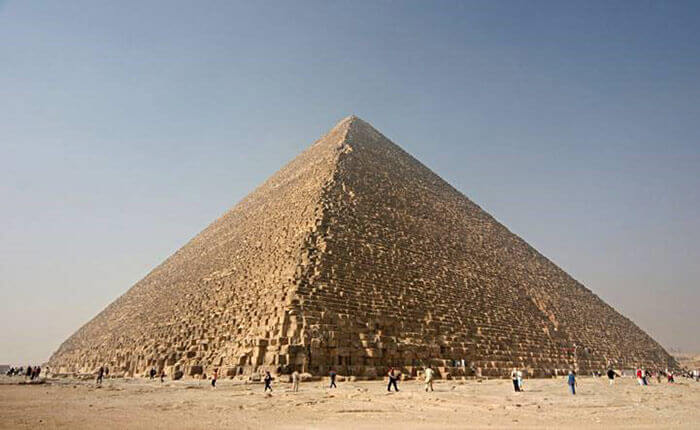 |
| Khufu’s Pyramid, also known as the Great Pyramid of Giza, is the oldest and largest of the three pyramids in the Giza pyramid complex bordering what is now Cairo, Egypt. It was built as a tomb for Fourth Dynasty Egyptian King Khufu over a 20-year period concluding around 2560 BC. The pyramid is 750 feet long on each side, 450 feet high and is composed of 2,300,000 limestone blocks, each averaging 2.5 tons (5000 pounds) in weight. |
|