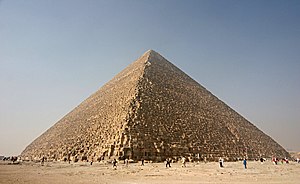
| The Great Pyramid of Giza |
 |
| Khufu |
II. “Egypt Built the Pyramids—and the Pyramids Built Egypt”
What were the pyramids? It appears they were elaborate temples or enclosures, houses and tombs, symbols of the immortality of the Pharaohs and permanence of Egyptian civilization. The Great Pyramid of Giza, built as a tomb for the Pharaoh Khufu around 1575 B.C., consisted of approximately 2,300,000 individuals blocks of stone each weighing over 2.5 tons on the average.
What motives would generate this extraordinary, monumental project? Most of us share the intuition that building pyramids revolved around the desire or quest for immortality. Pyramids were made of limestone and granite, substances not easily destroyed. Pyramids embodied the fantasy that some things could last forever.
Many of the Pyramids still stand, but the Pharaohs—in spite of mummification efforts—are long dead. Do any of us remember the name even of a single Pharaoh? Perhaps only King Tut, and perhaps because of the song Steven Martin sang on the Saturday Night Live show: “Now when he was a young man, he'd never thought he'd see, People stand in line, to see the boy king. King Tut. How'd you get so funky? Funky Tut. Did you do the monkey?”
What enormous sacrifices were required to build the pyramids! Norman O. Brown says that the ambition of civilized man is revealed in the pyramid—the hope of immortality. Death is overcome, Brown says, on condition that the real actuality of life pass into these “immortal and dead things.” Pharaohs sequestered the energies of the Egyptian people to build monumental structures that functioned in the name of denying death.
The image that many of us have of the men who built the pyramids is that of slaves: people who worked under the bidding and whip of the Pharaoh and his taskmasters. Recent archaeological findings suggests that the construction of the pyramids may have occurred more along the lines of a national project in which most of Egyptian society participated.
Zahi Hawass and Mark Lehner’s reinterpretation of the pyramids is based on excavations that reveal what appears to be a village or encampment where the people who worked to build the pyramids lived. Evidence from this site suggests that the living conditions of the pyramid workers were better than people had assumed.
Evidently they often had their families with them; their diet was more varied than had been expected; and there are signs that they were provided with medical care. Hawaas proposes that building the pyramid was the national project of Egypt—“everyone had to participate.”
Mark Lehner claims that the picture of a highly centralized bureaucracy going through the land and conscripting people for labor by force is highly doubtful. Rather, local rulers, heads of villages and estates, etc. would send laborers to the royal house. Thus, because the labor pool was a rotating force contributed by local authorities from all over Egypt, the Pyramid project may have had a “tremendously socializing effect.”
Lehner provides a sense of what may have occurred and what people may have experienced as they came from all parts Egypt to work on building the pyramid at Giza:
And so here are these stupendous, gigantic things thrust up to the sky, polished white limestone, blazing in the sunshine. And then they go on down to Giza and they come around this corner, actually the corner of the Wall of the Crow right into the harbor, and there's Khufu, the biggest thing on the planet actually in the way of a building until the turn of the century 20th century. And you see, for the first time in your life, not a few hundred, but thousands, probably, of workers and people and industries of all kinds.
And you're rotated into this experience and you serve in your respective crew, gang, phyles and division, and then you're rotated out and you go back because you have your own large household to whom you are assigned on a kind of an estate organized society. You have your own village; maybe you even have your own land that you're responsible for. So you're rotated back but you're not the same. You have seen the central principle of the first nation state in our planet's history, the pyramids, the centralization, this organization. And so they must have been powerful socializing forces.
The "central principle of the first nation state in our planet's history"! It was a “coming together of people from throughout the land.” Working on the pyramids acted to “socialize information” and “bound all these disparate areas and provinces into a whole.” It was, Lehner believes, the “beginnings of Egyptian unity.” The focus of his research, Lehner says, is not so much how the Egyptians built the pyramids, but how the “pyramids helped to build Egypt.”
The Pyramid, Hawaas explains, was a monument that symbolized the might and power of the royal house. Every household from Upper to Lower Egypt participated in the construction of the Pharaoh’s tomb by sending food, materials and manpower. Lehner suggests that the centralization and organization generated by the project of building the pyramids brought about the “first nation-state in our planet’s history.”
The project of building the Pyramids, in short, functioned to unify the Egyptian state. One might say that the people rallied round the Pharaoh to assist him in bringing to fruition his dream of eternal life. This was a dream with which the Egyptian people identified. Hawaas even suggests that the Pyramids were built by volunteers motivated by “love.”
Based on my research on Hitler and Nazism, I do find this interpretation reasonable. The man-in-the-street views Hitler as a dictator, but historians know that what held Germany together was the attachment of the people to Hitler and Nazi ideology. At the Nuremberg rallies, people came to a gigantic stadium from all parts of Germany. Coming together in this way—just as people came together from all parts of Egypt to build the Pyramids—the German people felt they were united as single community.
III. The Desire to Submit
The Pharaoh was the “living incarnation of the community.” The community lived and flourished vicariously--through the person of the king. People could share and partake of the fantasy of immortality embodied in the idea of the Pyramid. They too could imagine that it was possible to live forever.
There is a dialectical relationship between the elevation of certain human beings into the status of divine kings or totalitarian leaders, on the one hand, and submission to these political leaders on the other. It is not that people in power force human beings to submit. Rather, human beings create symbols of absolute power to give them the opportunity to submit.
Hitler was one of the most popular political leaders of the 20th century. Films of mass-rallies in auditoriums and stadiums depict Hitler—speaking hysterically and gesticulating wildly—bringing audiences to their feet in unison, shouting “Heil Hitler.” Worshipping Hitler as if he was a god, the German people submitted to him.
Upon joining the army, German soldiers vowed that they were prepared to offer their lives at any time to Adolf Hitler. The SS-man pledged “obedient unto death.” On September 26, 1938, Hitler spoke before a crowd of 15,000 after having given the Czechs an ultimatum. The mob interrupted every sentence of Hitler’s speech with fanatic applause, shouting and chanting, “Fuhrer command, we will follow.”
Rudolf Hess declared, “We follow Hitler’s orders and thus we prove our faith in him.” Bland terms like “obedience to authority” and “following orders” do not convey reality. It is not that human beings simply "go along" with political leaders. Rather, there is a profound tendency to identify with people in positions of power and what they represent—to submit to them in order to partake of the omnipotence they are imagined to possess.
Human beings want to believe in the existence of powerful people like divine kings and totalitarian leaders who are not obligated to submit to ordinary rules; are permitted to do things ordinary people are not allowed to do. Kings, for example, can mobilize great armies and ask military personnel to kill people en masse.
|

