|
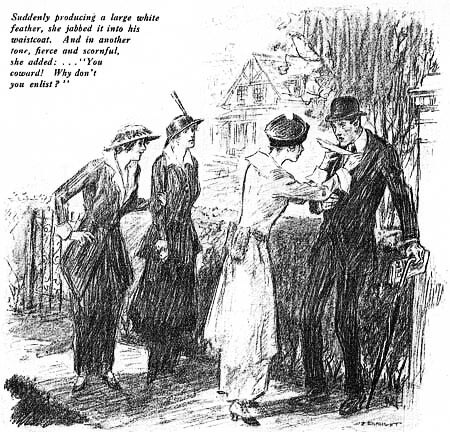
If a man didn't consent to fight in the First World War, "slackers" often would be scorned and humiliated by the "White Feather" women (see image directly below). Admiral Charles Fitzgerald warned British men that if they did not enlist a danger awaited them "far more terrible than anything they can meet in battle."
BETTER TO BE SHOT DEAD THAN TO FACE THE WRATH OF A WOMEN
|
Suddenly producing a large white feather, she jabbed it into his waistcoat. And in another tone, fierce and scornful, she added: "You coward! Why don't you enlist?"
| Image from 'The White Feather: A Sketch of English Recruiting' by Arnold Bennett, Collier’s Weekly 1914 |
|
On August 30, 1914, Admiral Charles Penrose Fitzgerald, an inveterate conscriptionist and disciple of Lord Roberts, deputized thirty women in Folkstone to hand out white feathers to men not in uniform. The purpose of this gesture was to shame "every young 'slacker' found loafing about the Leas" and to remind those "deaf or indifferent to their country's need" that "British soldiers are fighting and dying across the channel." Fitzgerald's estimation of the power of these women was enormous. He warned the men of Folkstone that "there is a danger awaiting them far more terrible than anything they can meet in battle," for if they were found ‘‘idling and loafing to-morrow" they would be publicly humiliated by a lady with a white feather.
|
About the Author: Nicoletta Gullace is Associate Professor of History at the University of New Hampshire, where she teaches history and international affairs. Her research interests are in modern Britain, European cultural history, and women's history.
|
|
Book by Nicoletta Gullace
In this extraordinary study of the complex relationship between war, gender, and citizenship in Great Britain during World War I, Nicoletta F. Gullace shows how the assault on civilian masculinity led directly to women's suffrage. Through recruiting activities such as handing out white feathers to reputed "cowards" and offering petticoats to unenlisted "shirkers," female war enthusiasts drew national attention to the fact that manhood alone was an inadequate maker of civic responsibility. Proclaiming women's exemplary service to the nation, feminist organizations tapped into a public culture that celebrated military service while denigrating those who opposed the war.
|
|
