Perception of Political Units grows out of the Experience of One's own body
Richard Koenigsberg/Howard F. Stein
  • Howard Stein's concept of PSYCHOGEOGRAPHY is extremely powerful (scroll down to read about this concept and his book DEVEOPMENTAL TIME, CULTURE SPACE. I've elaborated upon and refined this concept with my observations directly below.

    Richard Koenigsberg
    _____________________________________________________________________
  1. Perception of political units grows out of the experience and perception of one’s own body. The body is externalized into political units. Fantasies about the body are projected into the nation. The body politic is a double of the self, symbolizing the self.
     
  2. Nations are experienced as if fused with the body, which is why we get so excited about them. We defend nations desperately because they are experienced as extensions of our bodies.
     
  3. Metaphorical language conveys the bodily meaning of abstract ideas. Metaphorical language in political rhetoric contains and reveals bodily fantasies. Metaphors originate in the body and externalize phantasies about the body. Metaphors convey bodily experience.
     
  4. Modell: “Primary metaphors are derived from bodily sensations and projected outward.”  Bodily experiences and fantasies are projected into politics units.
     
  5. Countries are symbols or mental representations, not real entities. As mental representations, they are not separate from, but are bound to bodily experienced.
     
  6. Analysis of metaphors in political texts is the methodology for perceiving how unconscious phantasies (about the body) are externalized into political and cultural symbols. 
     
  7. Analysis of metaphorical language reveals bodily symbolism. To study bodily metaphors (in political texts or rhetoric) is to understand the "transformational equation" (Howard F. Stein) whereby fantasies about the body are transformed into symbolic systems.
A limited number of copies of the hardbound edition are available at a special rate from Amazon. Please Order now.

Howard Stein has been called “one of the finest minds engaged in the study of culture in our time” (Howard Schwartz, Oakland University) and “One of the world’s most original thinkers in the human sciences.” (Robert Endleman, author of Psyche and Society).

A few hardbound copies are still available through Amazon.

Click through here to order your copy niw.

“The scope of psychogeography is the unconscious construction of the social and physical world. Men and women fashion the world out of the substance of their psyches from the experience of their bodies. They project psychic contents outward.”

“Fantasies about the body are transmuted into descriptions of one’s own group, and other groups—into shapes and features of the world. Projected outward, the fate of the body becomes the fate of the world.”

PSYCHOGEOGRAPHY is the study of the psychology and social construction of BOUNDARIES: How we delineate inside and outside; who is to be included and who excluded. How do personal boundaries come to be felt as co-extensive with the boundaries of one’s group?

“People seek secure boundaries,” Stein says, in order to “differentiate between us and them, inside and outside, good and evil.” Boundaries must be closed, and “anything which might threaten the perfection of greatness within must be excluded.”

Psychogeography is the study of how nations build walls in order to protect citizens from “demonized dangers from beyond the borders” (Daniel Brownstein).

Please order immediately to obtain your copy.

HOWARD F. STEIN is a psychological anthropologist and Professor at the University of Oklahoma Health Sciences Center. He is the author of fourteen books and over one hundred scholarly papers.

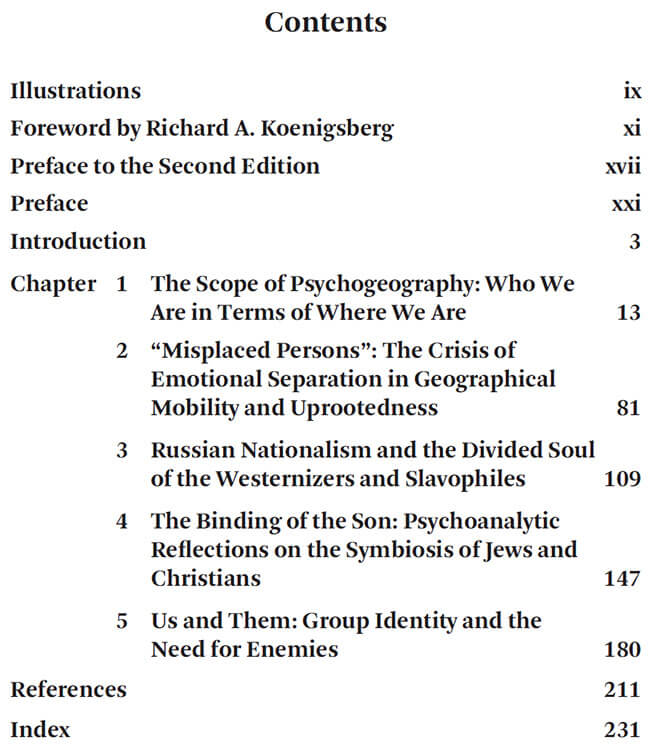
Developmental Time, Cultural Space: Studies in Psychogeography

Howard F. Stein