|
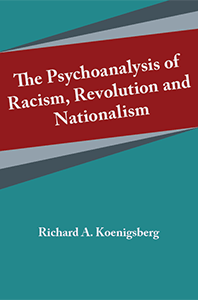
Richard Koenigsberg’s The Psychoanalysis of Racism, Revolution and Nationalism provides insight into the nature and meaning of nationalism, an ideology so dominant in our lives--that we don't know what it is.
The idea of the nation--although we accept and embrace is as an absolute reality--is a discourse or social construction. What are the sources and meanings of this MATRIX in which we conduct our daily existences and from which we cannot escape.
Praise
“A truly bold and provocative treatise: The nation is seen as the symbolic embodiment of a communal narcissistic ego, cleansed of the 'badness' introduced by a particular class of people within a nation's boundaries whose 'removal' by whatever means is easily rationalized if goodness is to be restored. The interpretations are intriguing and illuminating, the scholarship creative and careful.”
—Dan B. Thomas, Political Psychology (Journal).
|
Introduction to Chapter I:
“THE COUNTRY, THE MOTHER, AND INFANTILE NARCISSISM”
One may view the idea of the nation as an "assumption" defining how modern man perceives and experiences social reality. As people once possessed absolute faith in the reality of God, so people in contemporary societies possess absolute faith in the reality of the nation.
People differ regarding the stance taken in relation to nations: the country may be "loved" or hated; perceived to be "healthy" or sick; "strong" or weak. Whatever stance is adopted, people are united—within the culture of nationalism—by their absolute faith in the reality of this entity and by their belief that this entity constitutes a fundamental determinant of the nature of their daily lives.
An ideology is embraced and perpetuated—attains a degree of "power" as an element of culture—insofar as it provides a modus operandi for the expression and discharge of phantasies shared by human beings. The central tasks this book, therefore, is to uncover the nature of the unconscious phantasies that define and sustain the ideology of nationalism.
In this Chapter, we focus upon three core phantasies: the phantasy of the nation as a suffering mother; the phantasy of the nation as an omnipotent mother; and the nation as a projection of infantile narcissism.
|
|
The Psychoanalysis of Racism, Revolution and Nationalism
Richard A. Koenigsberg
Table of Contents
I. The Country, the Mother and Infantile Narcissism
- Introduction
- The Country as Suffering Mother
- The Country as Omnipotent Mother
- The Country as a Projection of Infantile Narcissism
II. The Country as a Living Organism
- Racism and Revolution as a Wish to Eliminate the "Disease" from Within the
Body of the Nation
- The Disease Within the Nation as a Projection of Malignant Internal Objects
III. Revolution as a Struggle against Passivity
- The Struggle Against Passivity: Hitler
- The Struggle Against Passivity: Lenin
- The Struggle Against Passivity: Aurobindo
IV. The Social Psychology of Nationalism
- The "National Community"
- Totalitarianism
- The Renunciation of Personal Gratification in the Name of a Devotion to the Collectivity
|