LIBRARY OF SOCIAL SCIENCE is reviewing the 3210 Newsletters we've published over the past 5+ years as we let go of the past and gather force for our next thrust into reality. What has endured and what bas become obsolete? Which authors' insights continue to develop and deepen and which have fallen into the dustbin of history?
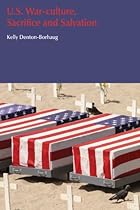
Dr. Kelly Denton-Borhaug, Professor of Religion and Co-director, Peace and Justice Studies at Moravian University keeps on keepin' on. She is a powerful theorist and holds to her view that warfare is an institution revolving around sacrificing the lives of human beings to the nation-state. We have presented excerpts from her classic US WAR-CULTURE, SACRIFICE AND SALVATION below.
She is available for presentations in person or virtually. Please contact her at:
Email: denton-borhaugk@moravian.edu
Phone: 610-625-7104
______________________________________________________________________
Abstract: If the search for greater honesty about ourselves requires peeling back the layers of sacrificial logic, memorials have the effect of tying our hands behind our backs. We are invited to honor those who participated in the war and especially, to mourn and honor those U.S. military who died, but we are not invited to question or ponder further. Ultimately, memorials continue the process of reification of a particular national identity, an identity that comes from war, and from a deep cognitive framework regarding belief in the redemptive nature of violence and the necessity of sacrifice to achieve freedom and justice.
|
WAR-CULTURE, CHRISTIANITY AND THE CULT OF THE FALLEN SOLDIER
During the period of the First World War, with the experience of literally hundreds of thousands sacrificing themselves for the nation, the cognitive connection between war and Christianity became clear. One scholar wrote:
- Christian symbols, indeed, the very figure of Christ, were present in the cult of the fallen soldier—and in Germany, Italy and France, familiar Christian symbols represented nationak sacrifice. The First World War was a climax in the evolution of modern nationalism, and in its quest for totality, the nation sought to co-opt Christianity.
|
Nationalism has been described as a religion, yet with insufficient attention paid to the theme of sacrifice that binds the experiences of nationalism and the Christian religion, forming a sacred canopy encompassing both religious and national self-identity.
The human resort to sacrifice is so ubiquitous as to reside largely 'off the radar screen' of overt awareness. As a result, analysis of sacrifice is simultaneously all the more difficult and all the more important.
Blood sacrifice is at the heart of war-culture's and the warrior's 'religiosity.' Because of this, to question the cognitive framework of sacrifice, residing as a deep and largely unexamined anchor for warriors' identity, is a kind of heresy.
Christian proclamation that portrays the work of Christ as a sacrifice cements the architecture of this social structure in Western cultures such as the United States. To cast doubt on the soldier's mission as sacrifice is as unsettling, challenging and jarring to common sensibility, questioning the sacrality of Christ's sacrificial death on the cross.
CHRIST AND THE MYTH OF THE WAR EXPERIENCE
In Germany, Greek ideals melded with Christian frameworks to create a grounding from which the actual experience of war would be confronted and transcended. The deaths of young soldiers were justified as a sign of military commitment, and glorified as a type of idealized inner control. At the same time, popular exclamations, such as 'Now we are made sacred,' juxtaposed the sacrifice of soldiers with the death and resurrection of Christ.
In this way, the passion of Christ became an analogy for the experience of the nation as a whole: through sacrificial deaths of the most worthy citizens, Christ was understood to illuminate the very world, such that war itself was interpreted as a strategy for Christological revelation. Suffering as a purifying force was recommended to the troops in the trenches; more widely, suffering was advised to the nation as a whole, to lead to a stronger and purified Germany, 'encased in armor.'
This popular piety grew into an important resource that could be manipulated to overcome fear of death itself. Eternal life, assured to those who had sacrificed themselves for the nation, now outweighed any value of the importance of living in the here and now. The expectation of an eternal and meaningful life—the continuation of a patriotic mission--not only seemed to transcend death itself, but also inspired life before death.
The corresponding growth of war memorials and cemeteries for the war-dead cemented and extended these frameworks. These sites became popular destinations and shrines of public worship and pilgrimage following the war, and the development of commercial measures, such as cheap tours for mourners, enabled increasing numbers of civilians to participate in the growing cult.
The actual experience and dread of war thereby was 'cleansed,' or we might say, thrust into the distance. And once this took place, it was all too easy for the 'Myth of the War Experience' successfully to refocus the memory of war. Not long after, the Nazis reinvigorated this cult and made their own martyred dead central in its observance of the 'Myth of the War Experience'.
|
PEELING BACK THE SACRIFICIAL LOGIC
If the search for greater honesty about ourselves requires peeling back the layers of sacrificial logic, memorials have the effect of tying our hands behind our backs. We are invited to honor those who participated in the war and especially, to mourn and honor those U.S. military who died, but we are not invited to question or ponder further. Ultimately, this memorial continues the process of reification of a particular national identity, an identity that comes from war, and from a deep cognitive framework regarding belief in the redemptive nature of violence and the necessity of sacrifice to achieve freedom and justice.
But such questioning leads to serious consequences, for once we begin to understand and interrogate these destructive connections, the cognitive 'transcendentalization' of war and war-culture begins to dismantle in our minds. A new kind of consciousness or awareness about our reality begins to dawn upon us. This is not necessarily a comfortable awareness or consciousness, because it is attended by many new questions.
'Detranscendentalizing' war and war-culture unsettles formerly unquestioned assumptions and values. How then should we think about what soldiers do? How will we describe their deaths if not as sacred sacrifice? Moreover, how will we understand the nation, its purpose, and our connection to it? What will we do differently with respect to decision-making regarding conflict and the use of armed force?
Finally, the exploration of these links also forces the question about the relationship of Christian following to American civil religion. What will it mean to uncouple Jesus’ death on the cross from the powerful national narrative of Christ’s sacrificial death as the archetype for the necessary sacrifices made in war to preserve 'the American way of life'?
Detranscendentalizing war-culture means taking up these important questions, destabilizing some dominant frames of understanding, and reemphasizing others.
|
|