|
Dear Colleague,
Many of you noted that the "link" to my review of Norman O. Brown's Life against Death in the Newsletter sent out earlier today was not working. Thank you for notifying me. Below is what you requested.
We are not yet monetizing our Newsletters--but will be soon, even though my primary objective is not to "make money," but to generate a revolution in human thought.
I don't need "praise," this fatuous academic concept. I who I am and know what I know. But I do long for INTERACTION with others who will dialogue and help develop these ideas. I explained to the Executive Director of the Library Social Science, Andrew Hammer and also to our Webmaster, Mostafa Boieblan, that the job of most academics is to create resumes.
However, I also told Hammer and Mostafa that probably 7% of scholars in the academic world are genuinely are motivated by the pursuit of truth. Probably you are one of these since you are opening and reading this.
WRITE AN ESSAY FOR THE NEWSLETTER. It can be a response to this Newsletter,or any other recent Newsletter. 500-1000 words in length. Don't hide in an underground bunker (subject of an upcoming paper by Keven Volkan). We look forward to receiving and publishing your thoughts.
Best regards,
Richard Koenigsberg
PS: We'll promote one of your books with each essay we publish.
PPS: REVIEW OF NORMAN O. BROWN'S BOOK IS DIRECTLY BELOW.
______________________________________________________________
Review Essay of Life Against Death: The Psychoanalytical Meaning of History
Richard A. Koenigsberg
Brown, Norman O., Life Against Death: The Psychoanalytical Meaning of History. Middletown, CT: Wesleyan University Press, 1985. 387 pp. $28.95 U.S. (pb.) ISBN 0819561444. (Originally published in 1959).
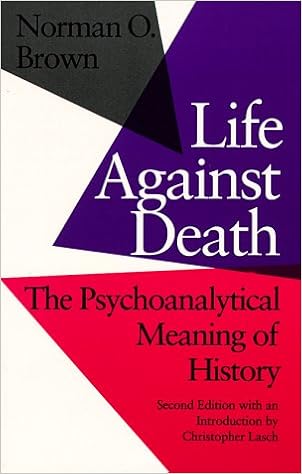
"One of the most interesting and valuable works of our time. Brown's contribution cannot be overestimated. His book is far-ranging, thoroughgoing, extreme, and shocking. It gives the best interpretation of Freud I know"—Lionel Trilling
Norman O. Brown was Professor Emeritus of Humanities at the University of California at Santa Cruz. He is considered one of the most important thinkers of the Twentieth Century. He was my first Professor.
Brown's book is one of the most significant written on the psychoanalytic interpretation of culture and history. If you have not read it, now is the time to do so. Brown sets forth a vision expanding the scope and meaning of psychoanalysis beyond the clinical setting.
For information on how to order, PLEASE CLICK HERE.
Read at no charge: Excerpts from LIFE AGAINST DEATH.
Freud's vision has yet to be understood or actualized. Neurosis and psychosis don’t happen simply within individuals. Neurosis and psychosis are all around us. (RAK note today: Now, in 2023, this seems obvious, but still this is rarely written or spoken about. Why is this is the case?).
Politics, in particular, is that dimension of culture that allows neurotic and psychotic fantasies to be projected into reality and enacted. However, we don’t call our political world neurotic or psychotic, however “insane” it appears to be. We don’t have a language to characterize psychopathology that occurs in society. Indeed, we often fail to recognize that the world in which we exist is one we have created. Brown says, "Projections bring the inner world into external reality, but only under the sign of negation or alienation.”
Brown sets forth a vision for the psychoanalytic interpretation of culture and history that has not yet been actualized. Why has this project had difficulty making its way into the world? Perhaps most significantly, psychoanalysis is identified with the clinic, mode of therapy. Brown, on the other hand, aspires to “reshape psychoanalysis into a wider theory of human nature, culture and history” to be “appropriated by the consciousness of mankind as a new stage in the historical process of man’s coming to know himself.”
One of the fundamental concepts of psychoanalysis is that of transference. However, as Herman Nunberg suggests, why should we imagine that the transference mechanism occurs only within the psychoanalytic situation. We may assume that transference occurs at all times and in all places.
Human beings project fantasies into the external world and enact them on the stage of culture. Society, Brown says, is “one vast arena in which the logic of the transference works itself out.” The “fantasies that create the human neurosis cannot themselves be directly apprehended or mastered,” but their “derivatives in human culture can.”
We live today within a bizarre, violent political world this ten years ago) which people call "reality." Many scholars claim that society functions according to "rational principles" (if they still do so today, there are high-paying, important subway maintenance jobs in New York City).
Brown states that “Projections, with their fetishistic displacement of inner fantasies, distort the external world.” Well, perhaps “distort” is not the correct word—since many cultural forms are based precisely on projection—the displacement of inner fantasies into the outer world. Neurotic and psychotic fantasies are projected into reality and enacted.
However, we don’t call the political world neurotic or psychotic, however “insane” it appears to be. We don’t have a language to characterize psychopathology that occurs in society. Indeed, we often fail to recognize the world that we have created as our own. Ideologies or institutions such as warfare seem to be “out there on their own.” It often seems as if what occurs in culture comes from another world. As Brown puts it, projections bring the inner world into external reality, but only “under the sign of negation or alienation.”
Who created the symbolic order? Who creates discourse? What is the source of the “power” of society?” Freud observed that the mythological conception of the universe, which survives in the most modern religions, is fundamentally psychology projected into the external world.
Brown suggests that not just mythology, but the entirety of culture is a projection. In the words of Stephen Spender, “The world which we create—the world of slums and telegrams and newspapers—is a kind of language of our inner wishes and thoughts.”
What a radical idea! What an obvious idea. That we human beings are the source of that which exists. We have created social forms because they represent the fulfillment of our desires and function to allay anxiety. It’s now to say that reality is a social construction. But constructed based on what? By whom?
We have no trouble acknowledging this truth—that human beings are the source of cultural forms when it comes to airplanes or air-conditioners or baseball games or Hershey bars. Obviously, these social forms exist because they represent the fulfillment of our desires. We have more difficulty acknowledging that we human beings are the source of war, genocide and the desire to create atom bombs. With regards to these societal institutions, human beings pretend that they have nothing to do with them.
The fact that human beings have created the pathological world in which we exist should be the starting point for the study of culture and history. Yet we rarely focus on this obvious fact. The essence of human psychology is denial.
Brown says that when we project unconscious fantasies into the world to create society, we perceive what manifests “only under the general sign of negation or denial.” We project fantasies into the external world, then deny that we are the source of what we have created. This splitting off of culture from the self represents a fundamental and extremely powerful dynamic. We imagine that the world of culture exists as if a domain of reality separate from us.
One may suggest that the following dynamic—particularly in the domain of politics—governs the creation of many cultural forms. First, a fantasy is projected into an ideological structure. The shared fantasy establishes the shape of an ideology or institution and is the source of the energy that sustains it.
Second, human beings deny that they are responsible for the institutions and forms of behavior that have come into being as a consequence of fantasies that have been projected into reality. We pretend that the ideology or institution exists as a dimension of society—but that we have had nothing to do with creating or sustaining it.
Brown suggests that once we recognize the limitations of talk from the couch (or recognize that talk from the couch is still an activity in culture), then it becomes plain that there is “nothing for psychoanalysis to psychoanalyze” except these projected fantasies that constitute culture. Thus, Brown says, psychoanalysis “fulfills itself only when it becomes historical and cultural analysis.”
But who will psychoanalyze the shared fantasies—those projections that are the source of the nightmare of history? Apparently not the psychoanalysts huddled away in their “clinics.” There has been nothing more destructive to Freud’s aspirations than the identification of psychoanalysis with the “clinical situation.”
Freud’s vision has yet to be understood or actualized. Neurosis and psychosis are all around us, embedded within civilization. Perhaps the domain of politics especially is where human beings manifest and enact their deepest fantasies and anxieties.
It’s difficult to know and say this. We are unable or unwilling to acknowledge that civilization itself contains or constitutes a radical form of pathology. We are oppressed and repressed by this symbolic object—”society” or “the nation”—in which we have invested so much psychic energy. We tremble before it, lest it destroy us, yet refuse to abandon it: like an abused child that refuses to separate from its mother.
|