|
Human beings die and kill to prove the reality of a sacred idea or ideal or entity. The nature of the idea or ideal or entity in the name of which people have died and kill is fungible. Among the significant ideals or entities for which people have died in the Twentieth Century are the following:
- France
- Germany
- The British Empire
- The (Japanese) Emperor
|
- Allah
- Freedom and democracy
- A Tamil homeland
- A more perfect union
|
The mechanism is the same regardless of the nature of the ideal or entity. Death validates the ideal or entity, testifying to its truth.
Subsequent to the event which generated death, memorials often are erected in the name of those who have died (see below). Memorialization serves a validation function. Death in warfare and memorials honoring those who have died constitute two sides of the same dynamic. Human beings die for a sacred entity or ideal, then memorials are erected to honor those who have died.
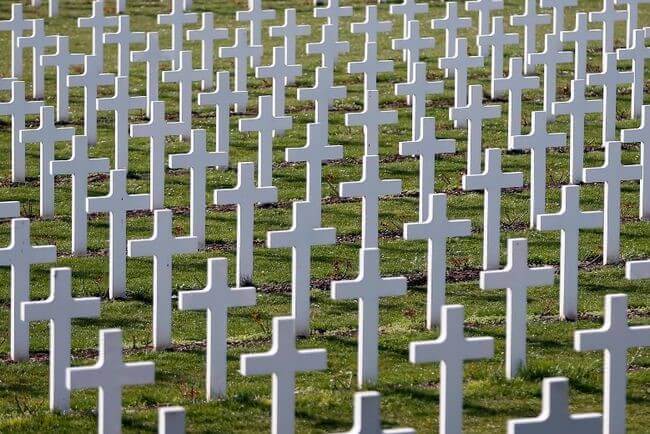
It is difficult to conceive that dying in battle occurred for no-thing. Crosses erected (like the ones below) perform a validation function. The proof of the pudding is in the dying and erection of memorials honoring those who "gave their lives" for the sacred ideal.
One may suggest that the purpose of the First World War (the "final solution") was the erection of these crosses, honoring soldiers who had died, testifying to the existence and power (the reality) of the nation-state.
|