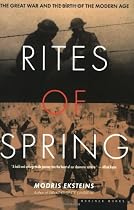
 |
Publisher:
Mariner Books
Author:
Modris Eksteins
Format: Paperback
ISBN-10: 0395937582
Language: English
Pages: 416 |
Dazzling in its originality, Rites of Spring probes the origins, impact, and aftermath of World War I, from the premiere of Stravinsky's ballet The Rite of Spring in 1913 to the death of Hitler in 1945. Recognizing that “The Great War was the psychological turning point for modernism as a whole,” author Modris Eksteins examines the lives of ordinary people, works of modern literature, and pivotal historical events to redefine the way we look at our past and toward our future. |
 |
Publisher:
Cambridge U. Press
Author:
Carolyn Marvin & David W. Ingle
Format: Paperback
ISBN-10: 0521626099
Language: English
Pages: 416 |
The authors argue that American patriotism is a civil religion organized around a sacred flag, whose followers engage in periodic blood sacrifice of their own children to unify the group. |
|
WHY ARE WE SHOCKED BY THE HOLOCAUST — BUT NOT BY THE FIRST WORLD WAR?
When people learned of the death camps, they were horrified. “Incomprehensible” was a common reaction. It was difficult to conceive that human beings could bring this event into existence, so disturbing that some people denied it occurred.
When I became aware of the First World War, I was shocked, horrified and appalled. This event too is nearly beyond imagination. It’s difficult to believe that leaders of “civilized” nations could ask men to get out of trenches for four years to be ripped apart — killed and maimed — by machine gun fire and artillery shells.
Here is a summary of the results of the First World War:
65 million men mobilized
8.5 million dead
21 million wounded
7.7 million POWs and missing
37 million total casualties
I was astonished when I first began my research on the First World War many years ago. But it seems historians were not. In their accounts, they rarely react with shock, surprise or amazement.
The term “incomprehensible” is never used.
|
Why does reaction to the Holocaust differ from reaction to the First World War? Please send your reflections to
|
MASS-MURDER: INTENTIONAL VERSUS ACCIDENTAL
In spite of monumental carnage, the First World War is not viewed as an “abnormal” historical event. Historians don't put the First World War — or any war — in the same category as the Holocaust. Why? Because we view the Holocaust as an instance in which a nation intentionally engaged in mass–murder, whereas historians do not view warfare as intentional mass-murder.
In the First World War, is wasn’t that nations actually desired to kill massive numbers of human beings. Rather, nations didn't realize what they were getting into. Things got out of control. It wasn’t as if anyone wanted what happened to happen. But what if we hypothesize that the First World War and the massive number of casualties was an event that some human beings wanted to occur.
|
Can we truly claim that killing during the First War World — 9 million dead — was unintentional? Please provide your own insights by writing to rakoenigsberg@libraryofsocialscience.com
|
WILLINGNESS TO DIE
Hundreds of books have been written seeking to fathom why some Germans were willing to murder Jews. Rarely are similar questions asked about participants in the First World War. Soldiers are expected to kill. When they murder, they are simply doing their duty. No explanation is required.
Regarding the First World War, we want to know — not only why soldiers were willing to kill — but why were they willing to die. Do we imagine that it is natural or normal for soldiers to go into battle and to die when leaders require that they do so?
Modris Eksteins poses the question of why soldiers continued getting out of trenches for four years — running into machine gun fire and artillery shells — when they knew that the results of this behavior were often fatal. In Rites of Spring (2000), he asks:
"What kept them in the trenches? What sustained them on the edge of No Man’s Land, that strip of territory which death ruled with an iron fist? What made them go over the top, in long rows? What sustained them in constant confrontation with death?"
The question of what kept men going in this hell of the Western Front, Eksteins says, is “central to an understanding of the war and its significance:”
"What deserves emphasis is that, despite the growing dissatisfaction, the war continued, and it continued for one reason: the soldier was willing to keep fighting. Just why he kept going has to be explained, and that matter has often been ignored."
I pose these questions:
- Why during the course of the First World War did national leaders continue to ask young men to engage in battle strategies that resulted in the deaths of millions of young men?
- Why did men continually follow orders — going "like sheep to the slaughter?"
|
Why were young men asked to get out of trenches and to run into
machine-gun fire and artillery shelling for four years? Why is this question
rarely posed? Please convey your thoughts by writing to rakoenigsberg@libraryofsocialscience.com
|
HOW MAY WE ACCOUNT FOR THE RECURRENCE
OF GOVERNMENTAL MASS- MURDER?
Carolyn Marvin’s theory of warfare, presented in Blood Sacrifice and the Nation (1999), helps us to answer this question. Marvin hypothesizes that “society depends on the death of its own members at the hands of the group,” that the underlying cost of society is the “violent death of some of its members.” In short, one’s nation or society “lives” insofar as members of one’s society die.
War is a ritual performed by nations — in order to claim sacrificial victims. Society, Marvin says, “depends on the death of sacrificial victims at the hands of the group itself.” The maintenance of civilization, society and the nation-state require the blood sacrifice of war.
Carolyn Marvin’s theory arose out of her study of United States history, yet works perfectly to explain the First World War, which may be understood as a massive, collective ritual of blood sacrifice. Societies acted to cause the deaths of young men — in order to keep their nations alive. In some instances (for example, Australia and Canada), blood sacrifice gave rise to the nation.
HE DESIRE NOT TO KNOW
Marvin’s theory explains why wars recur — their function for societies and human beings. Just as significantly, her theory seeks to explain the fact that we don’t want to know the truth: that warfare is sacrificial ritual. The occurrence of war—and denial of warfare’s purpose or function—are part of the same dynamic.
According to Marvin, knowledge that society depends on the death of sacrificial victims at the hands of the group is the “totem secret”; the “collective group taboo.” While we enact warfare as a sacrificial ritual, we simultaneously don’t wish to know that we are enacting this ritual.
Throughout the twentieth century, governments have been responsible for the deaths of hundreds of millions of human beings. Did each war and episode of genocide occur because of reasons unique to each event? Perhaps a more parsimonious hypothesis is that episodes of violence generated by societies and governments represented the fulfillment of collective desires.
Warfare is not forbidden. Indeed, we take it for granted that nations will wage war. It’s what societies do. This is what I mean when I say that human beings believe that Nations Have the Right to Kill (Koenigsberg, 2009). We are not forbidden to wage war, but are forbidden to know why we wage war.
|
Why were young men asked to get out of trenches and to run into
machine-gun fire and artillery shelling for four years during the First World War?
Why is this question rarely posed? Please convey your thoughts by writing to rakoenigsberg@libraryofsocialscience.com
|
|