|
Psychoanalysts once debated endlessly the nature and meaning of “symbiosis;” the “symbiotic phase of development" as it was called. (see Blass and Blatt, 1996).
Of course, having emerged from the womb, symbiosis is a fantasy rather than reality: we never again will be "at one" with another human being, however powerful is the fantasy of "returning to the womb."
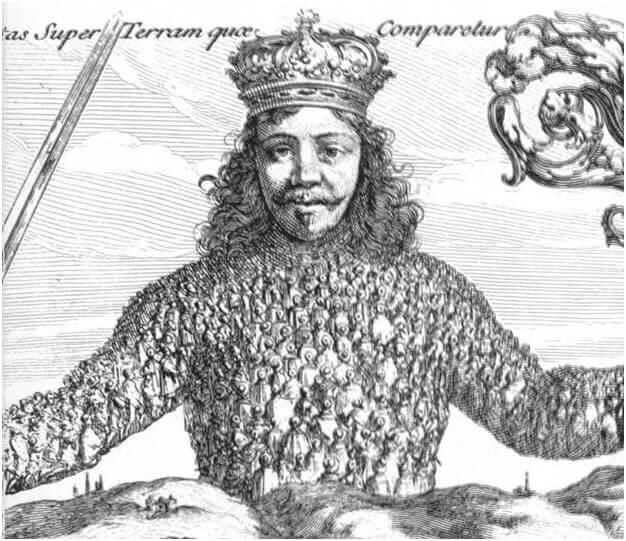
The definition of the term “merger:” “to sink or extinguish into one which is greater or superior.” This definition describes precisely the image presented in Hobbes’ Leviathan (see image directly below).
Mahler’s original definition remains the best. Symbiosis is:
"Hallucinatory or delusional, somatopsychic omnipotent fusion with the representation of the mother and, in particular, the delusion of a common boundary of the two actually and physically separate individuals" (Mahler, 1975/2000).
“Symbiosis” is not best understood as a “phase of development. Rather it is a primordial fantasy shaping or governing our relationship to "society" and the political domain.
Hobbes’ image (below) perfectly captures the fantasy of symbiosis: the bodies of individuals are imagined as existing in a state of “somatopsychic fusion.” There is no separation between the human bodies and the gigantic body of the sovereign.
The bodies of human being constitute the body of the sovereign. This is the core of symbiotic fantasy: no separation; fusion with an object conceived as omnipotent.
|
Hobbes, Thomas (1651). Leviathan.
|
| The frontispiece to Thomas Hobbes’s Leviathan depicts the head and torso of a long-haired, mustachioed man. Upon close scrutiny, it becomes evident that the man’s torso and arms are composed of tiny individual persons, crowded closely together, each looking toward the head of the composite Leviathan. |
|