|
Hitler proclaimed to his youth: “You are flesh of my flesh, blood of my blood. You are all one, belonging to me.” This was Hitler's deepest fantasy and most profound desire (see photo of Nuremberg rally directly below on the right): Hitler insisted that each German human being bind to his body to constitute a single body: his flesh and flesh of his people becoming one.
Hitler's idea was the fantasy conveyed by the famous frontispiece of Hobbes' Leviathan (see left below), which depicts a gigantic man whose torso and arms are composed of tiny individual men crowded closely together.
Each of tiny man was bound to the body of the sovereign. In Leviathan (1651), Hobbes stated that the way to create a Commonwealth is to “unite the multitude in one and the same person.”
Several observations about this image:
- The Sovereign does not exist without the little men bound to his torso and arms. Without them, he would be an empty shell of a man.
- Without the Sovereign, the little men could not exist: their very identities derive from the fact that they are bound to the body of the sovereign.
- The idea of "obedience to authority" is revealed through this image. "Obedience" is not an abstract idea rather is a psychosomatic experience. If one's own body is part of the body of the sovereign and governed by his brain, then it is impossible to opt out--o resist submitting to his brain or body. One exists only as part of the sovereign. One cannot resist the body of which one is a part.
Richard Koenigsberg
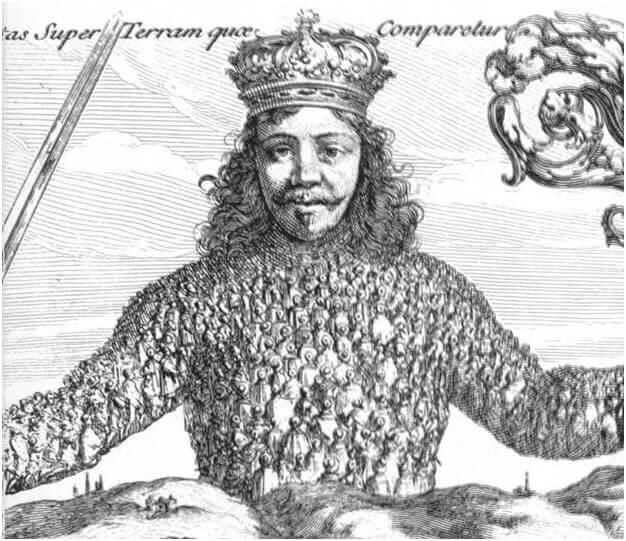
The frontispiece of Leviathan depicts a man whose torso and arms are composed of tiny individual persons crowded closely together. |
|
|
 Massive rally at Nuremberg (1937) composed of thousands of men crowded closely together. |
|
|
|
