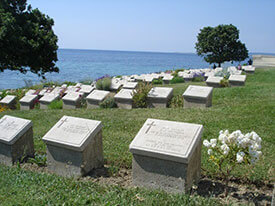
 ANZAC graves at Gallipoli |
 The Shrine of Remembrance in Melbourne—a memorial to all Australians who have served in war |
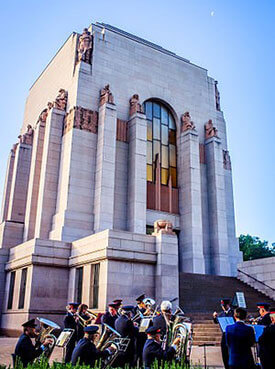 ANZAC Memorial, Hyde Park, Sydney |
|
Warfare grows out of a structure of thought—a template enacted in the world. For wars to occur, there needs to be an “enemy,” a class of people imagined to wish to harm or destroy one’s society and its sacred values.
Identification of an enemy generates the belief that it is necessary to wage war to defeat the group or class of persons threatening the existence of one’s society and its sacred values.
Waging war requires casualties. Soldiers who die are said to have made the “supreme sacrifice.” Their death is conceived as a gift to society: they gave their lives so that their nation might live.
After a war (or during it, as was the case in the First World War), nations create gravestones or monuments whose purpose is to preserve the memory of soldiers who gave their lives. Gravestones symbolize dead soldiers who sacrificed their lives for their nation.
The purpose of memorials is to honor the soldier and remember him for the sacrifice he made.
Gravestones honor those who made the "supreme sacrifice." The reward is the promise of immortality. By virtue of his sacrifice, the soldier will be “remembered forever more.”
The case of Australia demonstrates the relationship between nationalism, death in war, and memorialization or public remembrance. The Australian and New Zealand Army Corps (ANZACs) were part of a largely British force that landed at Gallipoli in April 1915 to attack the Ottoman Empire (now Turkey), which was fighting on the German side. This began an eight-month campaign.
The landing on the shores of Gallipoli was the first major military operation in which Australia, a newly federated nation, was involved. Thousands of Australians were slaughtered. Despite the utterly disastrous campaign, Australians instituted “Anzac Day” to remember and honor the courageous soldiers who lost their lives.
Australia finally could become a real nation. It had something to show the world—proof of the strength of the "Australian national character.” “Anzac” came to symbolize soldiers staying true to the “idea of Australian manhood.”
By virtue of their courage at Gallipoli, the world discovered the "character of Australian men.” Anzac “gave birth” to the Australian nation. The Australian nation came into being based on the slaughter of its young men.
Memorials exist to recall or remember sacrificial death, symbolizing soldiers who died(so their country may live). Commemorating the soldier suggests he did not die in vain. The gravestone, cross, or monument constitutes proof that the nation for which he gave his life exists. Wars are fought to produce sacrificial death--and memorials to the dead.
Thousands of memorials and monuments are scattered throughout Australia and have been visited by millions of Australians. These memorials and monuments symbolize soldiers who died for their country, testifying to the existence of the Australian nation.
Prime Minister P. J. Keating delivered a eulogy at the funeral service of the Unknown Australian Soldier on November 11, 1993:
The Unknown Soldier honors the memory of those men and women who laid down their lives for Australia. His tomb is a reminder of what we have lost in war and what we have gained. We have lost more than 100,000 lives and with them all their love of this country, and all their hope and energy.
We have gained a legend: a story of bravery and sacrifice and with it a deeper faith in ourselves and our democracy, and a deeper understanding of what it means to be Australian.
The Tomb of the Unknown Soldier honors the memory of those who laid down their lives for Australia. It serves as a poignant reminder of what was lost in war and what was gained. What was lost was 100,000 lives—the hopes and energy residing within these bodies--that now no longer existed. What was gained was a story of bravery and sacrifice that generated for citizens a “deeper faith:" an understanding of "what it means to be Australian."
I hypothesize that the purpose of war is to generate death to create a story or narrative, the purpose of which is to give citizens “faith” in their country. Gravestones or tombs are reminders or remembrances of soldiers who died, rekindling faith.
The body and energy of the soldier are transformed into a tomb. A soft, vulnerable human being becomes a rock (“solid as a rock, that's what our love is”) (please click link). The memory of the soldier’s sacrificial act—symbolized by a gravestone—reminds us of those who gave their lives so that their nation might live.
Richard A. Koenigsberg, PhD: (718) 393-1104
|