|
Richard Koenigsberg conceptualizes war as a societal ritual in which human death is instrumentalized to validate ideology and the reality of the nation.
Core Concept
Koenigsberg argues that modern warfare is not primarily about winning, territory, or defense, but about the sacrificial production of corpses to substantiate collective belief and national ideology  foundationforthestudyofpoliticalpathology.org+1. Soldiers are sent into battle not merely to fight, but to demonstrate devotion to the nation, with their deaths serving as a testament to the sacred ideals of the state foundationforthestudyofpoliticalpathology.org+1.
In this framework, war functions as a ritualized act where the body and blood of the sacrificed soldier anchor the reality of the nation, making abstract ideologies tangible  libraryofsocialscience.com.
Psychological and Symbolic Dimensions
Koenigsberg emphasizes the psychodynamics of human violence, showing how societies manipulate individuals to accept death as a form of devotion foundationforthestudyofpoliticalpathology.org+1. National identity becomes a powerful symbol, and individuals internalize it as an extension of the self, which can justify both killing and dying  thuppahis.com.
The act of dying in war is framed as a demonstrative process, where the magnitude of sacrifice validates the truth of the ideology or belief for which people fight libraryofsocialscience.com. This aligns with historical observations, such as Lincoln’s reference to the “last full measure of devotion,” highlighting the ritualized sanctity of death in service to the nation foundationforthestudyofpoliticalpathology.org.
Warfare as Ideological Proof
Koenigsberg’s analysis suggests that the institution of warfare revolves around truth: the deaths of soldiers and enemies serve to prove the sincerity and reality of national ideals foundationforthestudyofpoliticalpathology.org+1.
The frenzy of battle and visible consequences of death and injury create a perception that the nation and its ideology are real, not merely imagined. This perspective reframes war as a collective act of devotion, where the production of corpses is central to the affirmation of societal beliefs libraryofsocialscience.com.
Implications
By viewing war through this lens, Koenigsberg challenges conventional narratives of heroism, strategy, and victory. Instead, he highlights the ritualized, sacrificial, and symbolic nature of human destruction, urging a reconsideration of how societies understand and justify mass violence foundationforthestudyofpoliticalpathology.org+2. This approach also underscores the role of leadership and ideology in mobilizing populations to accept death as a necessary affirmation of collective identity thuppahis.com
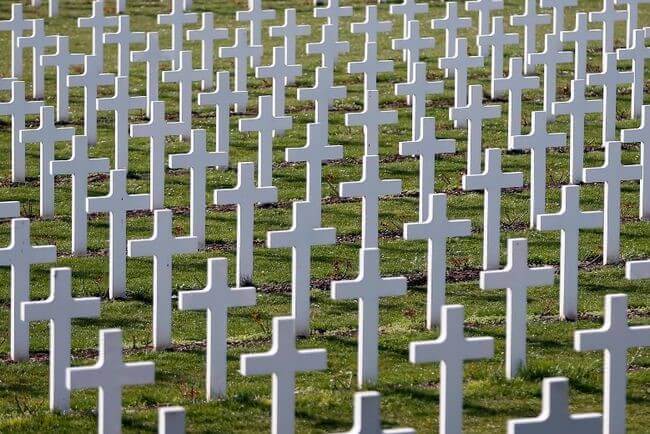
The crosses below were erected to honor soldiers who had died for their nations in the First World War. Was the First World War waged in order to erect crosses to the dead? To honor those who had given their lives to prove the reality of the sacred ideal?
|